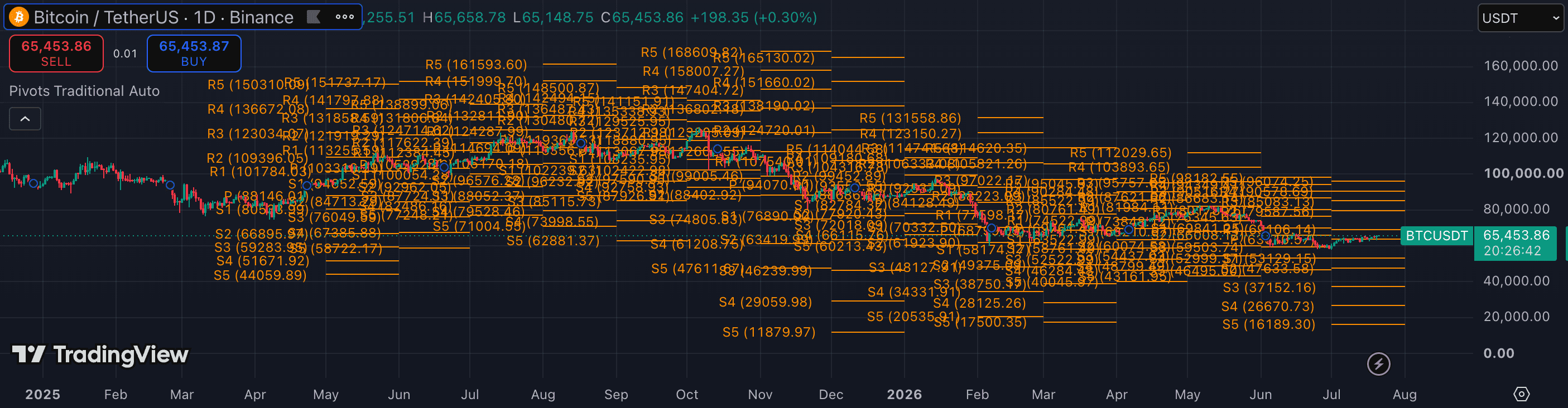
What Pivot does, and when it works.
Pivot Points calculate a central pivot (average of prior session's high, low, and close) and derive up to three support (S1–S3) and resistance (R1–R3) levels from it. The classic formula is session-based — on crypto that typically means the daily close — so new levels print each day. They are forward-looking price targets drawn before price gets there, which is why active day traders watch them closely.
The most reliable level is the central pivot: price above it favors longs for the session, below it favors shorts. The R1 and S1 are the first meaningful targets; traders routinely take partial profits at R1 during a trend day and look for reversals there during a range day. R2/R3 and S2/S3 are extension targets for high-momentum moves.
TradingView's built-in Pivot Points indicator lets you choose the calculation type (Traditional, Fibonacci, Camarilla, Woodie) and the anchor period (Session, Week, Month). For crypto day trading, Traditional anchored to the daily session is the most widely used — widespread use is part of the edge, since many participants are watching the same levels.