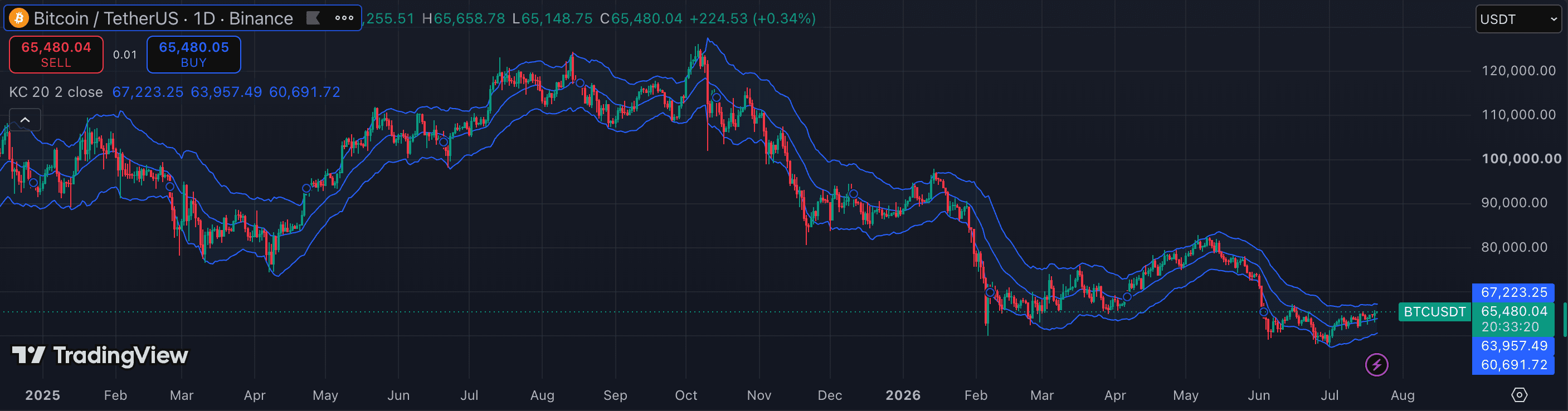
What Keltner does, and when it works.
Keltner Channels plot an upper and lower band around an exponential moving average, with band width set by a multiple of ATR. Unlike Bollinger Bands (which use standard deviation), the ATR-based width responds to true-range volatility — so the channel expands and contracts more smoothly on crypto's gappy overnight action.
The primary use is the squeeze setup: when Bollinger Bands contract inside the Keltner Channel, volatility is coiling. When the BBs expand back outside the KC, a breakout is typically underway. This Squeeze Momentum read is one of the cleaner breakout setups in crypto and works best on 1h–4h for BTC/ETH.
You can also trade the bands themselves: price hugging or pushing through the upper band signals strong trend momentum; a pullback to the midline (the EMA) is the standard re-entry zone in a healthy uptrend. Don't fade a channel walk-up in a strong trend — that is the pattern, not an error.