WaveTrend OscillatorvsStochastic RSI
Both are crypto-favoured momentum oscillators that fire earlier and reach extremes more often than plain RSI. They look similar on the chart — two lines, overbought/oversold zones, crosses as signals. But they measure momentum differently and perform best in different conditions.
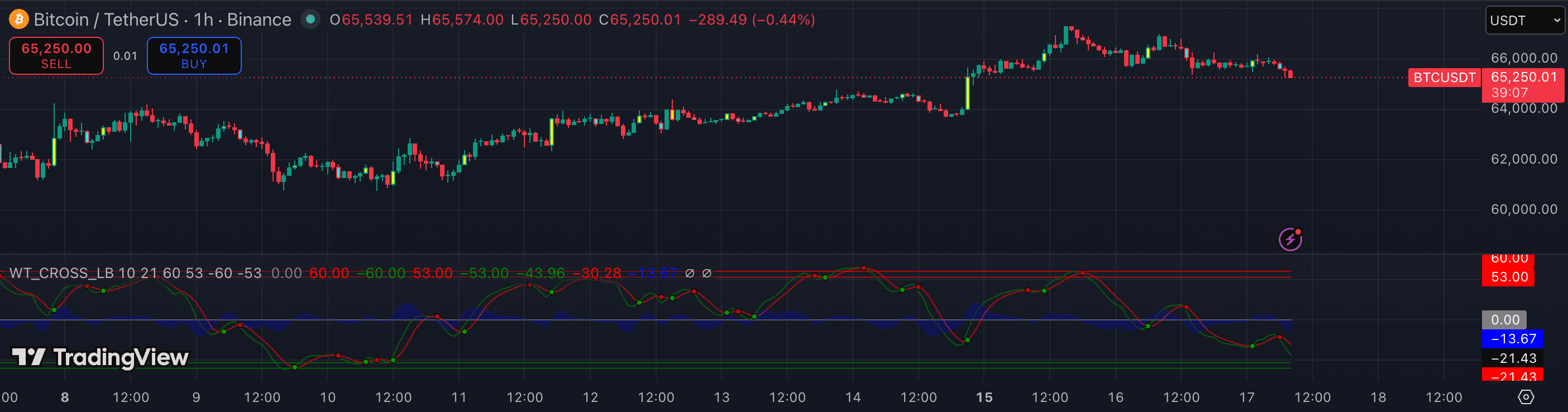
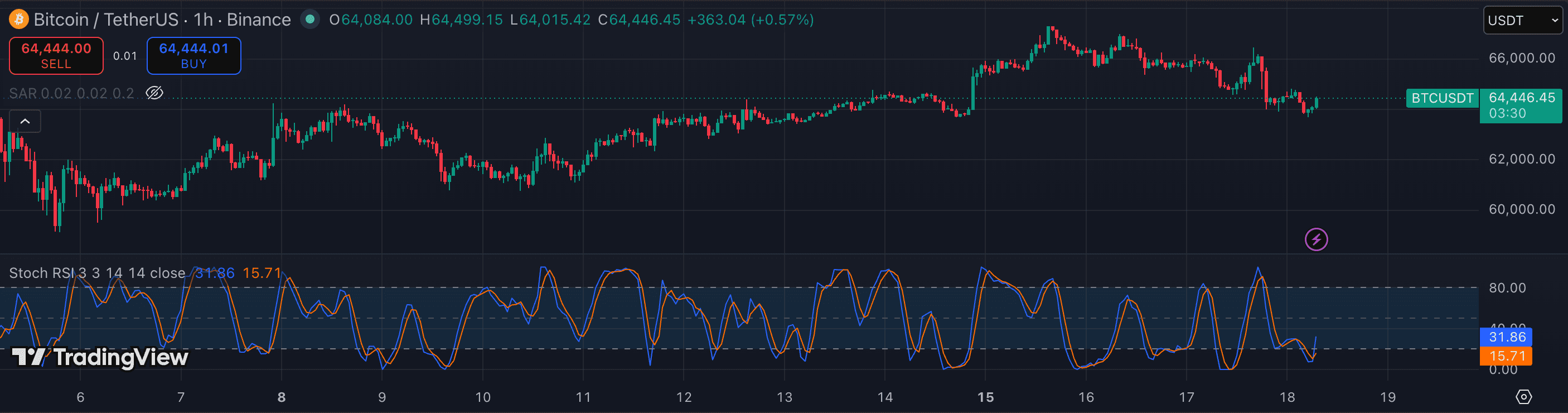
The attributes that matter.
| Attribute | WaveTrend Oscillator | Stochastic RSI |
|---|---|---|
| Category | Momentum | Momentum |
| Calculation basis | Smoothed price channel deviation | Stochastic formula applied to RSI values |
| Output | WT1 + WT2 lines, ±100 scale | %K + %D lines, 0–100 scale |
| Sensitivity | Moderate — intentionally smoothed | High — reaches extremes very frequently |
| Best timeframe | 15m · 1h | 15m · 1h · 4h |
| Divergence quality | ★★★★☆ — crypto-tuned divergence dots | ★★★☆☆ — fires often, lower signal quality |
| Best for | Mean-reversion on crypto majors | Precision entry timing within a trend |
| Worst in | Strong directional trends | Ranging markets — fires constantly |
Which should you choose?
WaveTrend and Stochastic RSI are both entry-timing oscillators, but they sit at different points on the sensitivity spectrum. WaveTrend's smoothing makes its crosses cleaner and its divergence signals more readable on crypto majors — it was designed with BTC/ETH 1h behaviour in mind and it shows. Stochastic RSI is more sensitive and fires more often, which makes it useful for precise pullback entries within a confirmed trend, but the higher signal frequency comes at the cost of more noise in ranging conditions.
The practical distinction: use WaveTrend when you want mean-reversion signals that hold up on 1h+ with minimal filtering. Use Stochastic RSI when you have a clear higher-timeframe bias already established and need a fast trigger to time the entry. If you only have room for one, WaveTrend is the better standalone tool; Stochastic RSI is the better entry timer when the direction is already decided.
- You want clean divergence reads on crypto majors
- You trade mean-reversion on 15m–1h without a strict trend filter
- You use VuManChu Cipher B and want to understand its core oscillator
- You have a trend bias established and need fast entry timing
- You trade pullbacks within confirmed trends on 15m–1h
- You prefer a two-line cross as a mechanical entry trigger
Other comparisons
Not investment advice. PineRadar is an editorial directory — links may be affiliate. Always test indicators on a demo account.