MACDvsStochastic
MACD and Stochastic are both momentum indicators, but they measure momentum differently — and they perform best in opposite market regimes. Understanding which regime you're in is the whole decision.
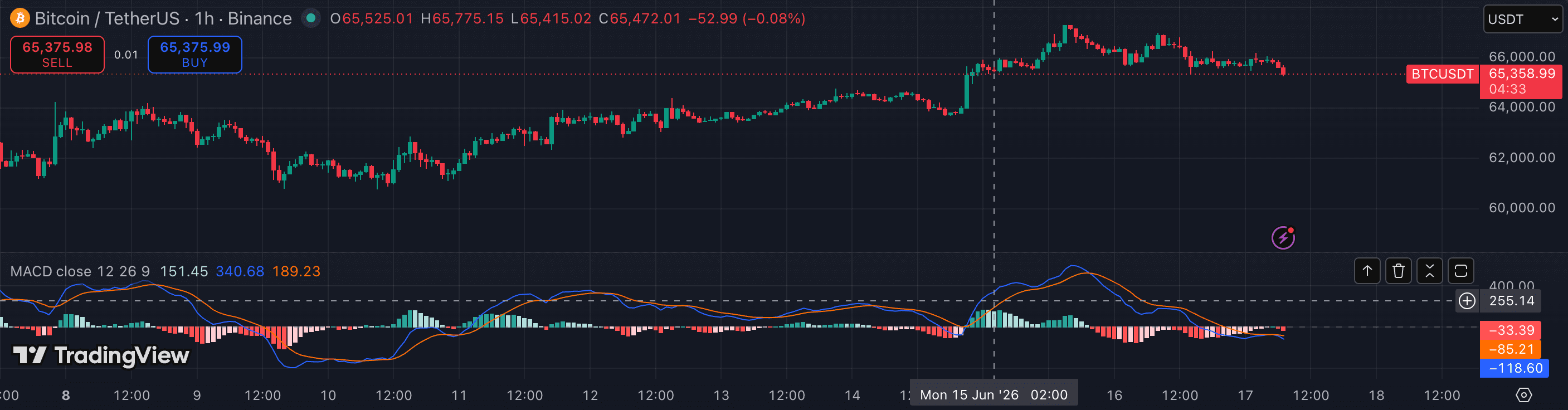
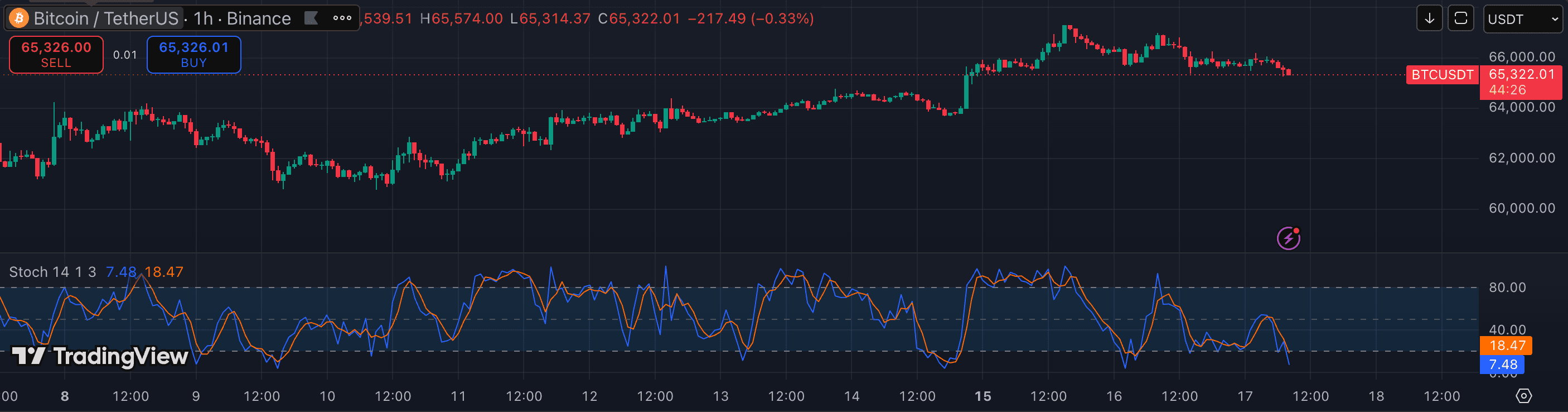
The attributes that matter.
| Attribute | MACD | Stochastic |
|---|---|---|
| Category | Momentum + trend | Momentum |
| Default period | 12, 26, 9 | 14, 3, 3 |
| Output | Two lines + histogram | %K + %D lines, 0–100 |
| Best environment | Trending markets | Ranging markets |
| Best timeframe | 1h · 4h · 1D | 5m · 15m · 1h |
| Lag | Higher — EMA-based smoothing | Low — reacts fast to price |
| Divergence quality | ★★★★☆ | ★★★☆☆ |
| Worst in | Sideways ranges (constant false crosses) | Strong trends (fires reversal after reversal) |
Which should you choose?
MACD and Stochastic are regime tools, not competitors: MACD belongs in trending markets, Stochastic belongs in ranges. MACD's EMA foundation means it lags but rides trends cleanly — the zero line gives you a trend filter and the histogram narrates momentum acceleration. Stochastic's fast reaction to price makes it useful for timing reversals in a defined range, but that same sensitivity generates constant false signals when price is in a directional move.
The practical setup: check whether the market is trending or ranging first (ADX above 25 = trend; below 20 = range). In a trend, read MACD for zero-line position and histogram direction. In a range, watch Stochastic %K/%D crosses near the overbought/oversold extremes. Running both simultaneously on the same timeframe mostly duplicates information — they tend to agree in trends and disagree in the ways that confuse more than clarify.
- You trade trends on 1h or above
- You want a trend + momentum read in one indicator
- You rely on divergence and early histogram warnings
- You scalp defined ranges on 5m–15m
- You want faster reversal timing with a two-line trigger
- You already have a trend filter and need an entry oscillator
Other comparisons
Not investment advice. PineRadar is an editorial directory — links may be affiliate. Always test indicators on a demo account.