Keltner ChannelsvsBollinger Bands
Keltner Channels and Bollinger Bands are both volatility envelopes — but Keltner's ATR-based width and smoother EMA core give it a distinct edge in specific setups. If you are trying to decide which envelope deserves the prime position on your chart, this is the comparison to read first.
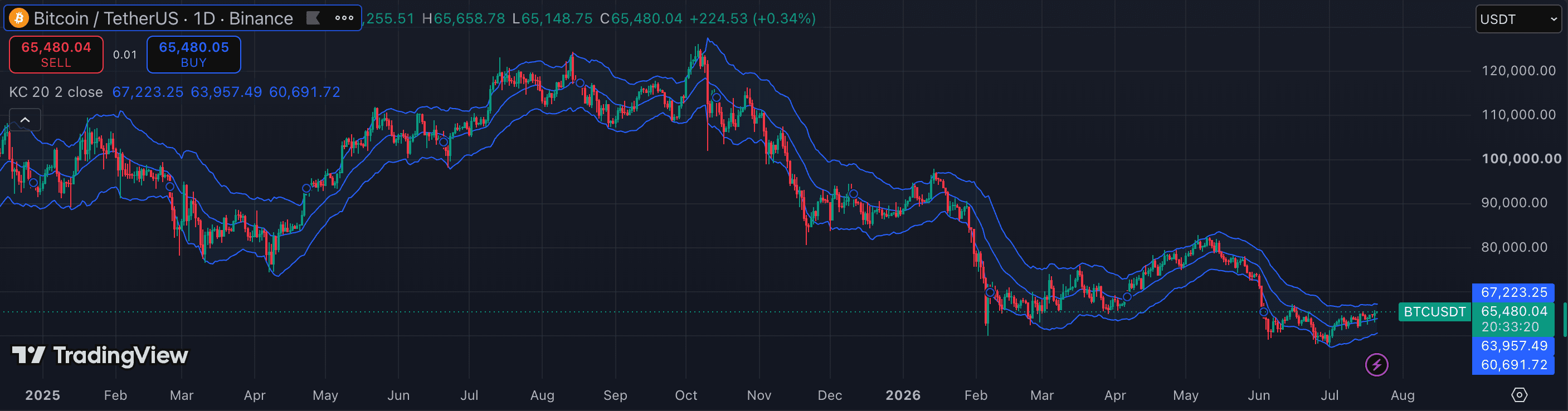
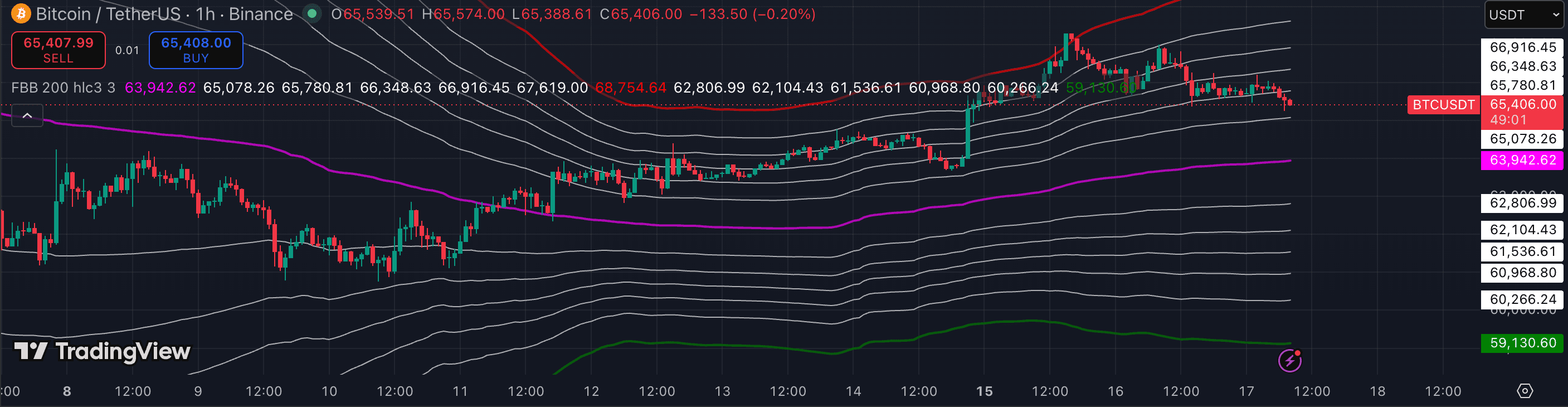
The attributes that matter.
| Attribute | Keltner Channels | Bollinger Bands |
|---|---|---|
| Category | Volatility | Volatility |
| Band calculation | ATR multiple | Standard deviation |
| Default period | 20 EMA, ×2 ATR | 20, ±2 std dev |
| Width behavior | Smoother — tracks true-range volatility | Spiky — reacts fast to price moves |
| Best timeframe | 1h · 4h · 1D | 15m · 1h · 4h |
| Best for | Squeeze confirmation + trend re-entry via midline | Mean reversion + squeeze detection |
| Worst in | Standalone use — needs BB for squeeze context | Strong trends (band tags ≠ reversals) |
| Squeeze role | Outside BB = squeeze released | Inside KC = squeeze trigger |
Which should you choose?
Keltner Channels' ATR-based width tracks true-range volatility rather than standard deviation, which makes the envelope significantly smoother on crypto's gappy, overnight-driven price action. In a fast impulsive candle, Bollinger Bands spike outward immediately — which can make a normal trend extension look like an extreme. Keltner Channels breathe more evenly, so the midline EMA remains a cleaner pullback re-entry level during an established trend.
The most valuable Keltner use-case is the squeeze setup: when Bollinger Bands contract inside the Keltner Channel, volatility is coiling. When BB expands back outside KC, the breakout is underway. In this setup, KC is the reference envelope — it defines what 'compressed' means. Bollinger Bands mean-revert well on their own; Keltner Channels provide the structural context that makes that mean-reversion signal actionable rather than arbitrary. If you only have room for one envelope on the chart, choose based on your primary strategy: KC for breakout and trend re-entry, Bollinger Bands for mean reversion and range trading.
- You trade breakouts and use the squeeze setup (BB inside KC)
- You want a smoother envelope for trend re-entry via the midline EMA
- You trade BTC/ETH on 1h–4h and get noise from BB's standard-deviation spikes
- You trade mean reversion and range setups
- You want to see overextension quickly via sharp band spikes
- You use Squeeze Momentum and need the BB component as the primary visual
Other comparisons
Not investment advice. PineRadar is an editorial directory — links may be affiliate. Always test indicators on a demo account.