Stochastic RSIvsStochastic
Both are oscillators derived from the same price-range logic, but Stochastic RSI adds an extra layer of sensitivity by applying the Stochastic formula to RSI values instead of price. The result is two tools that look similar but behave very differently. This comparison covers the practical distinctions to help you choose the right oscillator for your timeframe and style. For educational purposes only.
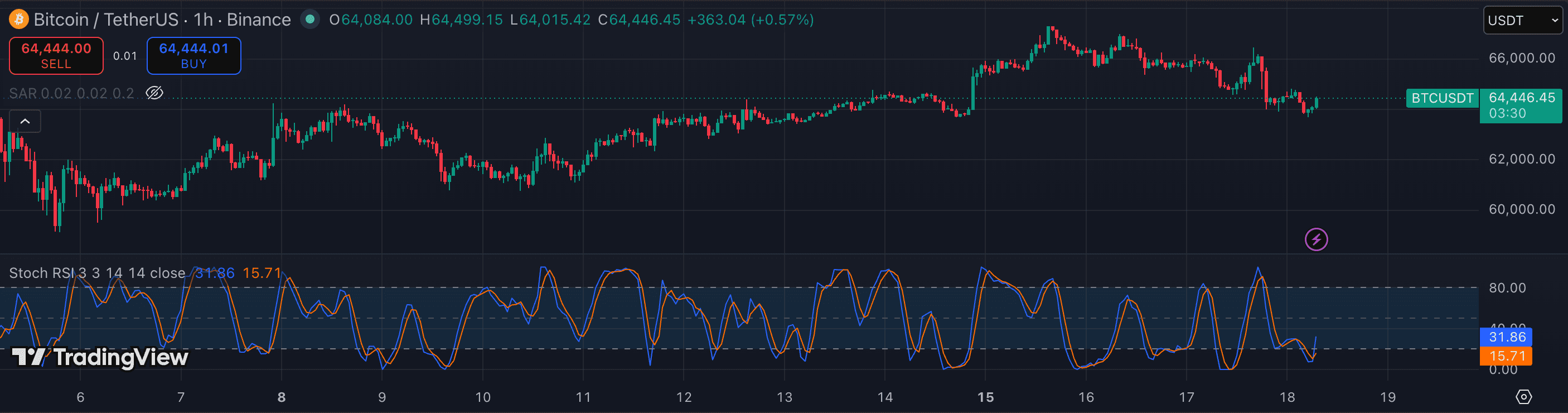
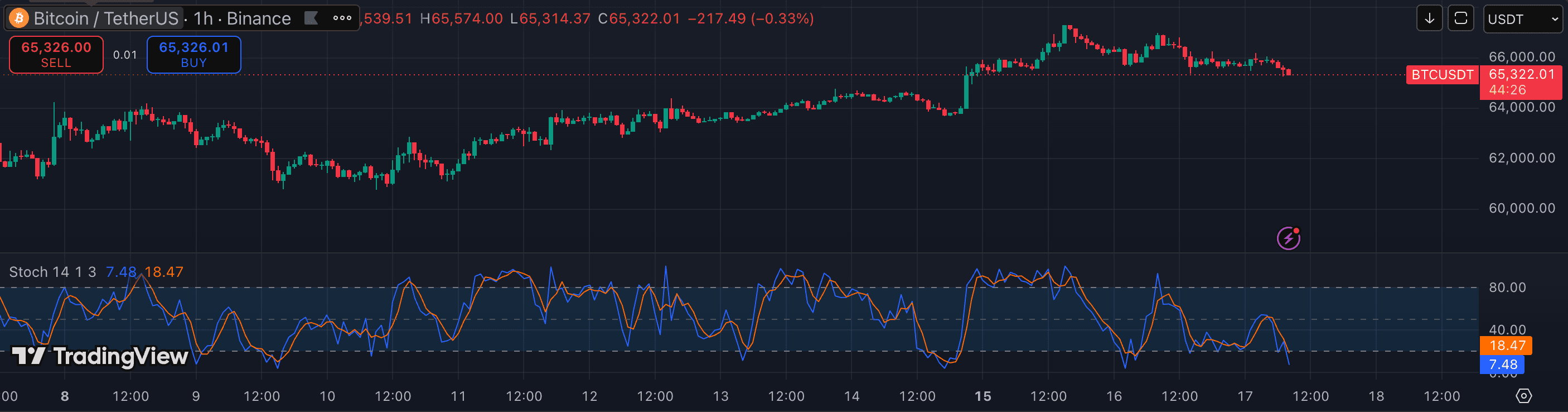
The attributes that matter.
| Attribute | Stochastic RSI | Stochastic |
|---|---|---|
| Category | Momentum | Momentum |
| Calculation | Stochastic of RSI (14), K=3, D=3 | Stochastic of price (14), K=3, D=3 |
| Output | %K + %D lines, 0–100 | %K + %D lines, 0–100 |
| Sensitivity | Very high — hits extremes far more often | High — faster than RSI but slower than Stoch RSI |
| Best timeframe | 15m · 1h (trend entry timer) | 5m · 15m · 1h (range scalping) |
| Signal quality | ★★★☆☆ — many false positives in ranges | ★★★★☆ — cleaner in defined ranges |
| Divergence quality | ★★☆☆☆ — too noisy | ★★★☆☆ — better than Stoch RSI |
| Best for | Pullback entry timing in an existing trend | Range reversals and mean-reversion scalping |
| Worst in | Sideways, choppy markets | Strong trending markets |
Which should you choose?
Stochastic RSI is the precision entry timer: because it applies the Stochastic formula to RSI (itself already a derived indicator), it reaches overbought and oversold levels extremely frequently — multiple times per session on 15m charts. That speed makes it useful for timing the entry bar in a trend pullback, but nearly useless for reading reversals on its own. You need an established directional context before Stoch RSI's cross means anything.
Stochastic is the cleaner range tool: it applies directly to price, so its readings are more grounded in what the market is actually doing. In a defined range — price bouncing between two clear levels — Stochastic's overbought/oversold crossovers are more reliable and its two-line structure gives a confirmation read that Stoch RSI lacks in choppy conditions. If you don't have a trend context, Stochastic is the safer oscillator.
The practical setup: use Stochastic RSI on your entry timeframe as a trigger after your higher-timeframe bias and structural read are in place. Use Stochastic on its own when you're in a range-bound market and you want oscillator signals without the added noise that Stoch RSI introduces.
- You already have a trend direction established and need a fast entry trigger
- You scalp or day-trade on 15m–1h with a clear HTF bias filter
- You want the fastest reversal signal available from a built-in TradingView indicator
- You trade defined ranges or mean-reversion setups
- You scalp 5m–15m without a firm directional filter
- You want cleaner overbought/oversold signals without the extra noise of a double-derived oscillator
Other comparisons
Not investment advice. PineRadar is an editorial directory — links may be affiliate. Always test indicators on a demo account.