WaveTrendvsMACD
WaveTrend and MACD are both momentum oscillators that show cycles and crossovers. But WaveTrend was built for extreme-level reversals while MACD was built for trend confirmation. Their differences are subtle on the surface and significant in practice.
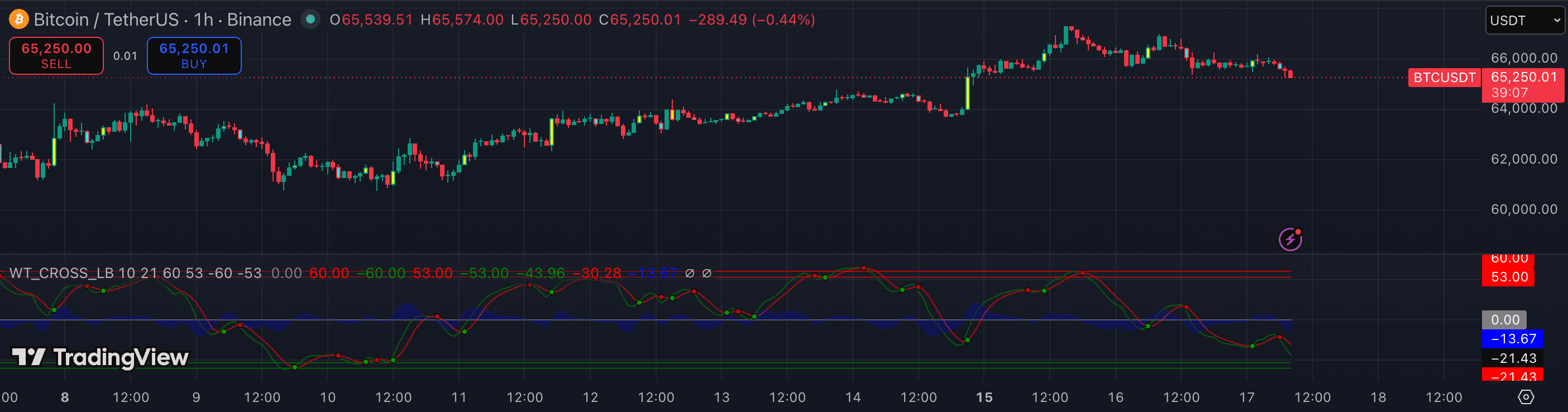
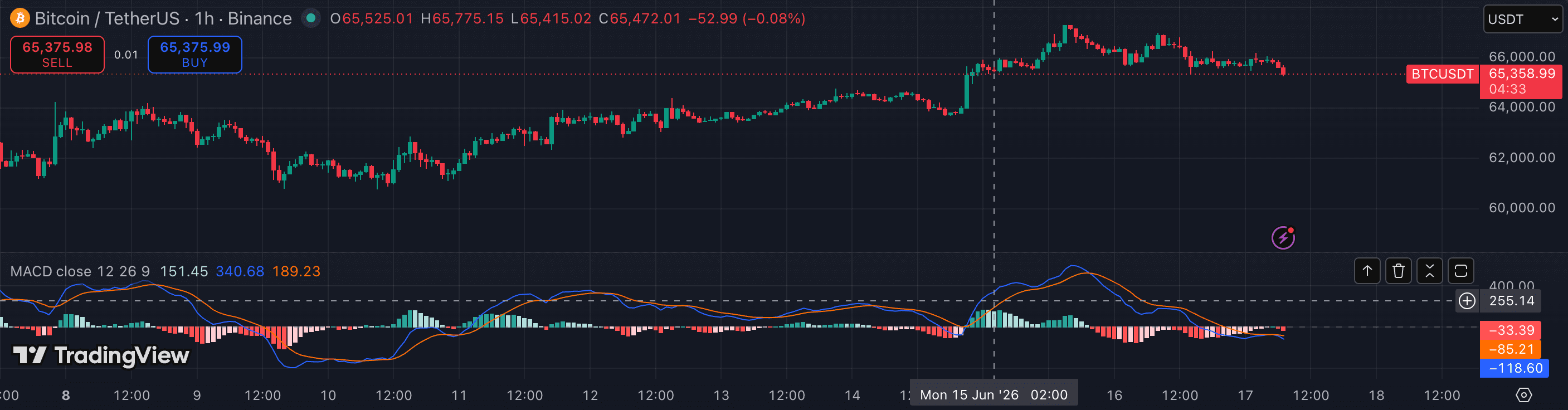
The attributes that matter.
| Attribute | WaveTrend | MACD |
|---|---|---|
| Category | Momentum (oscillator) | Momentum + trend |
| Core mechanic | Price channel oscillation, two-line cross | EMA crossover + histogram |
| Default period | Channel length 10 · avg 21 | 12 · 26 · 9 |
| Best timeframe | 15m · 1h · 4h | 1h · 4h · 1D |
| Lag | Low | Medium |
| Extreme-level signals | ★★★★☆ | ★★☆☆☆ |
| Divergence quality | ★★★☆☆ | ★★★★☆ |
| Best for | Overbought/oversold reversals in crypto | Trend direction & momentum fading |
| Worst in | Strong trends (stays extreme) | Tight ranges |
Which should you choose?
WaveTrend is primarily a mean-reversion tool: its two-line crossovers at extreme levels (above +60 or below −60) are the signal most traders look for, and it finds them quickly on crypto's volatile price swings. MACD is a trend-confirmation tool: it tells you whether an existing trend has momentum behind it and whether that momentum is fading via divergence.
For crypto scalping and swing-reversal setups, WaveTrend's speed and extreme-level precision give it the edge. For trend-following and higher-timeframe bias reads, MACD's divergence quality and histogram make it more reliable. Running WaveTrend on your entry timeframe and MACD on the bias timeframe is a practical combination.
- You trade reversals at extended highs and lows
- You scalp 15m–1h on crypto and want fast crossovers
- You already use Cipher B and want a standalone version
- You trade confirmed trends with pullback entries
- You want strong divergence signals on 4h–1D
- You need a bias indicator, not a reversal trigger
Other comparisons
Not investment advice. PineRadar is an editorial directory — links may be affiliate. Always test indicators on a demo account.