WaveTrend OscillatorvsVuManChu Cipher B
WaveTrend Oscillator is the foundation that VuManChu Cipher B is built on — so comparing them is really a question of how much complexity you want layered on top of the core signal. WaveTrend gives you the momentum cross in its purest form; Cipher B adds money flow, divergence dots, and RSI/Stochastic context on top. Here's what each adds and when the extra complexity earns its place. Educational content only; not financial advice.
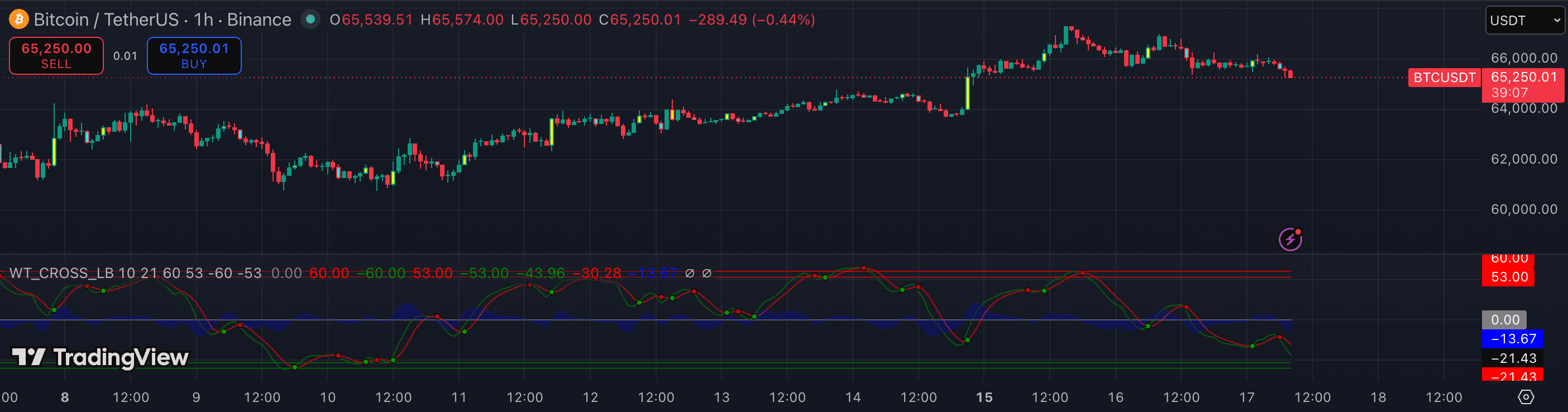
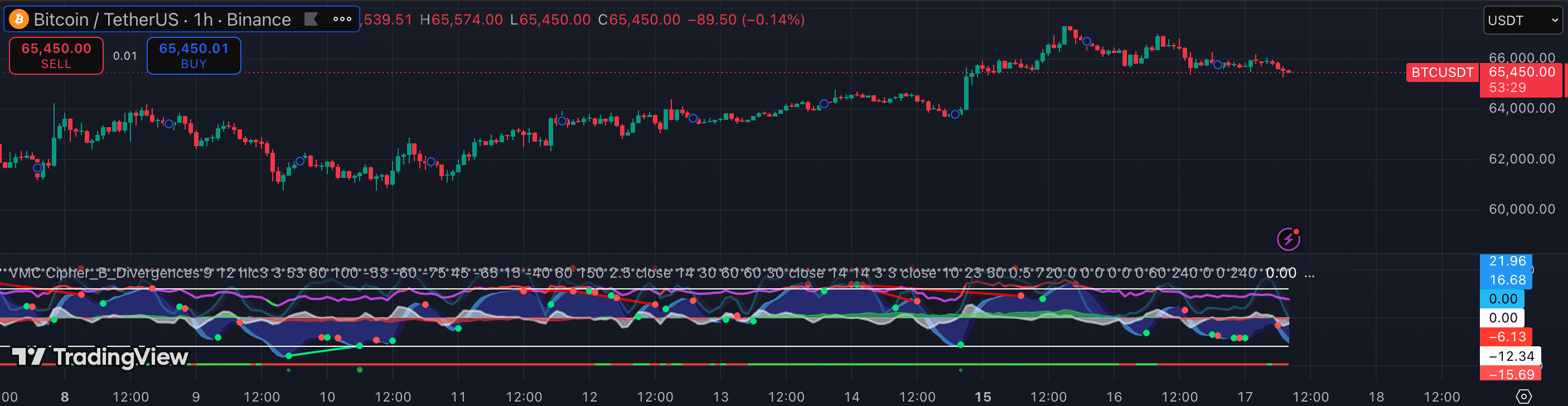
The attributes that matter.
| Attribute | WaveTrend Oscillator | VuManChu Cipher B |
|---|---|---|
| Category | Momentum oscillator | Signal / oscillator hybrid |
| Basis | HLC3 channel deviation → two smoothed lines | WaveTrend + money flow histogram + divergence dots |
| Output | Two lines (%1 + %2) — crossover is the primary signal | Wave lines + green/red money flow area + divergence dot markers |
| Complexity | Low — one oscillator, one signal type | High — three layered reads in one pane |
| Best timeframe | 15m · 1h · 4h | 15m · 1h · 4h |
| Divergence detection | Manual read required | Automatic divergence dots |
| Money flow read | None | Built-in money flow histogram (green/red area) |
| Best for | Clean crossover timing with minimal distraction | Confluence — momentum + money flow + divergence in one pane |
| Worst in | Strong trends — frequent mid-range crosses | Strong trends — same WaveTrend weakness, plus dot overload in chop |
Which should you choose?
WaveTrend is the engine inside Cipher B. If you strip Cipher B down to just the wave, you get WaveTrend. The question is whether the additional layers — money flow and divergence dots — improve your decision-making or add noise you can't act on reliably. For traders who are disciplined about waiting for dot-plus-money-flow confluence rather than every cross, Cipher B delivers a genuinely richer signal. For traders who find themselves reacting to too many dots, WaveTrend's simpler crossover is less cluttered and easier to filter with an external trend bias.
The practical differences: WaveTrend's %1/%2 crossover is the cleanest mechanical trigger of the two — it fires a binary event (cross) that is easy to implement as an alert. Cipher B's strongest signal is a green dot at an oversold extreme with money flow (the background area) turning from red to green simultaneously. That confluence — dot plus flow agreement — is a higher-quality event than a bare WaveTrend cross, but it requires reading three variables at once. For beginners, WaveTrend is the better starting point; for traders comfortable with Cipher B's multi-layer read, the added context is genuinely useful.
- You want a single, mechanical crossover signal you can act on without interpreting multiple layers
- You prefer minimal indicator clutter and use separate tools for divergence and flow reads
- You're learning oscillator-based trading and want a clean two-line structure to start with
- You want momentum, money flow, and divergence in a single pane to reduce chart complexity
- You already understand WaveTrend and want the additional confirmation layers Cipher B provides
- You trade liquid crypto altcoins where Cipher B's combined signals give higher-conviction entries
Other comparisons
Not investment advice. PineRadar is an editorial directory — links may be affiliate. Always test indicators on a demo account.