WaveTrend OscillatorvsRSI
Two of crypto's most-used oscillators, but they're built differently. WaveTrend applies a smoothed channel to HLC price; RSI measures the ratio of recent up-bars to down-bars. Both show momentum — they get you there by different routes. Educational content only; not financial advice.
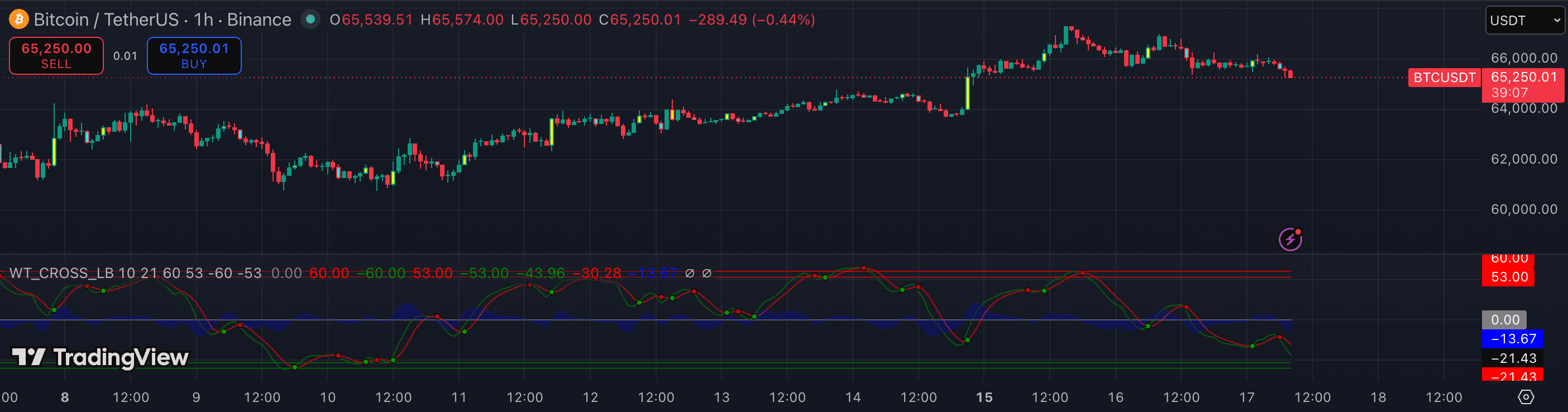
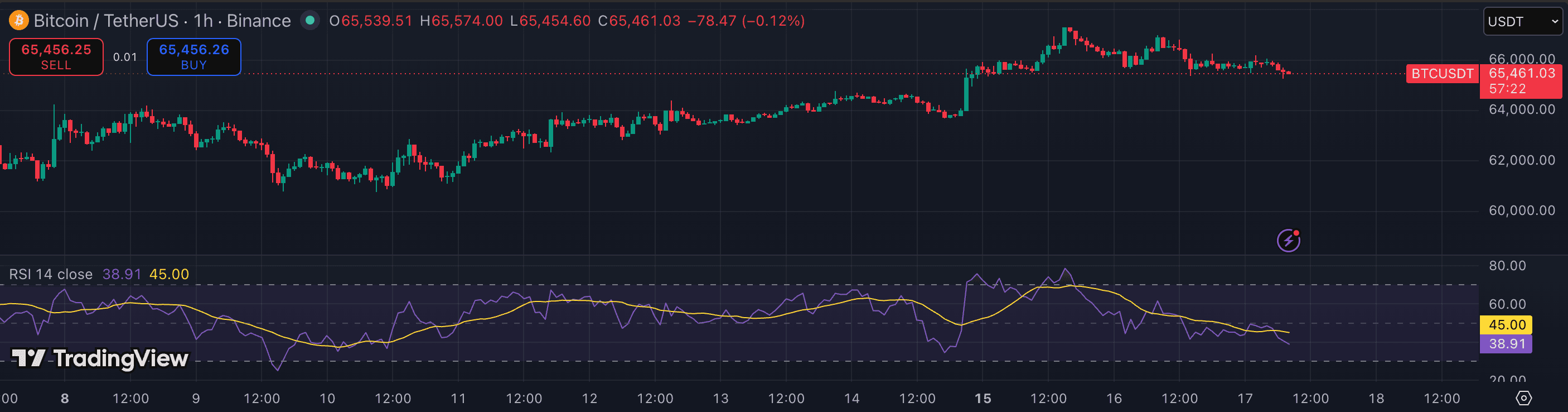
The attributes that matter.
| Attribute | WaveTrend Oscillator | RSI |
|---|---|---|
| Category | Momentum | Momentum |
| Basis | HLC3 channel deviation | Avg gain ÷ avg loss (0–100 scale) |
| Output | Two lines (%1 + %2) in an oscillator pane | Single line, 0–100 |
| Best timeframe | 15m · 1h · 4h | 1h · 4h · 1D |
| Lag | Low-medium | Medium |
| Divergence quality | ★★★★☆ — early signals, especially on alts | ★★★★☆ — most reliable on majors 1h+ |
| Crossover signal | Yes — %1/%2 cross is the primary trigger | No crossover — threshold and divergence only |
| Best for | Early momentum shifts and divergence on alts | Trend-exhaustion reads on BTC/ETH |
| Worst in | Strong trending markets (many false crosses) | Tight ranges (pins at extremes) |
Which should you choose?
WaveTrend's two-line structure gives you a crossover signal that RSI simply doesn't have — when the fast %1 line crosses above %2 in an oversold zone, many traders treat that as a buy trigger without needing to wait for price confirmation. On altcoins, this crossover tends to fire 1–3 bars earlier than an RSI-based signal. The trade-off is that in a strong trend, WaveTrend crosses chop constantly — it's not a trend-filtering tool.
RSI is the cleaner exhaustion read on BTC and ETH on the 1h and above. Divergence between price and RSI on those pairs and timeframes is one of the more reliable reversal tells in crypto. The 50 centerline also works as a momentum regime filter — traders who only look long when RSI is above 50 avoid a lot of counter-trend noise. RSI's simplicity is also a feature: because every chart trader understands it, reactions to RSI levels can be partially self-fulfilling.
A practical setup uses both: WaveTrend on the entry timeframe as a crossover trigger, and RSI on the higher timeframe to confirm the momentum regime is aligned. When WaveTrend crosses up and the higher-timeframe RSI is above 50, you're entering with both tools pointed the same way.
- You want an early crossover trigger, especially on altcoins
- You trade 15m–1h and want divergence that fires before price confirms
- You use a two-line oscillator structure for crossover-based entries
- You trade BTC/ETH on 1h and above and want a clean exhaustion read
- You rely on divergence as your primary reversal signal
- You prefer a single universally-understood oscillator with minimal configuration
Other comparisons
Not investment advice. PineRadar is an editorial directory — links may be affiliate. Always test indicators on a demo account.