Pivot PointsvsVWAP
Both are session-anchored day-trading tools that mark 'where price should react.' But they answer the question differently — one is calculated from yesterday's session, the other is updated live with today's volume.
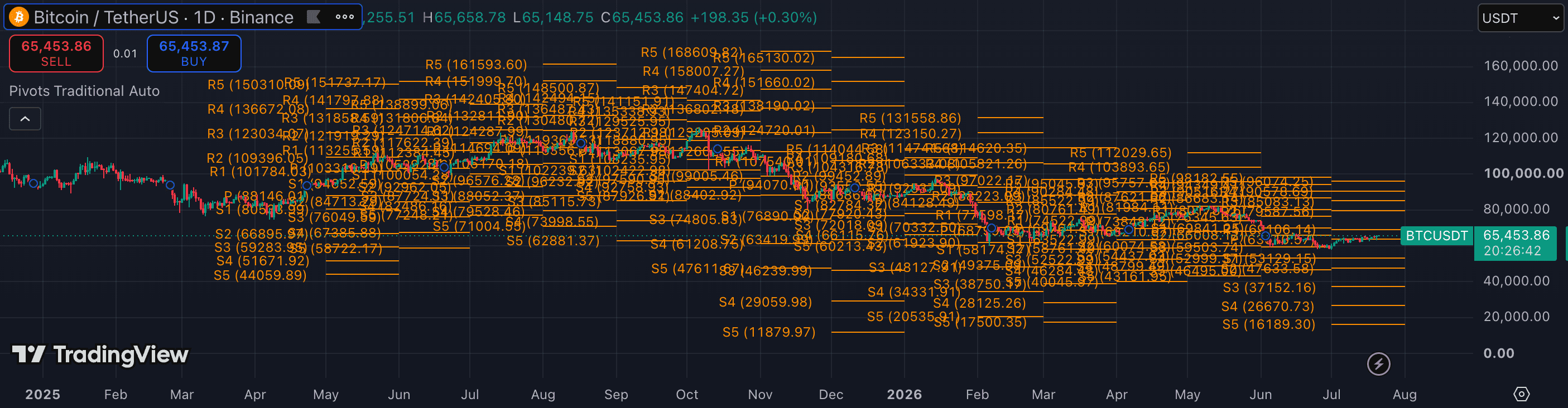
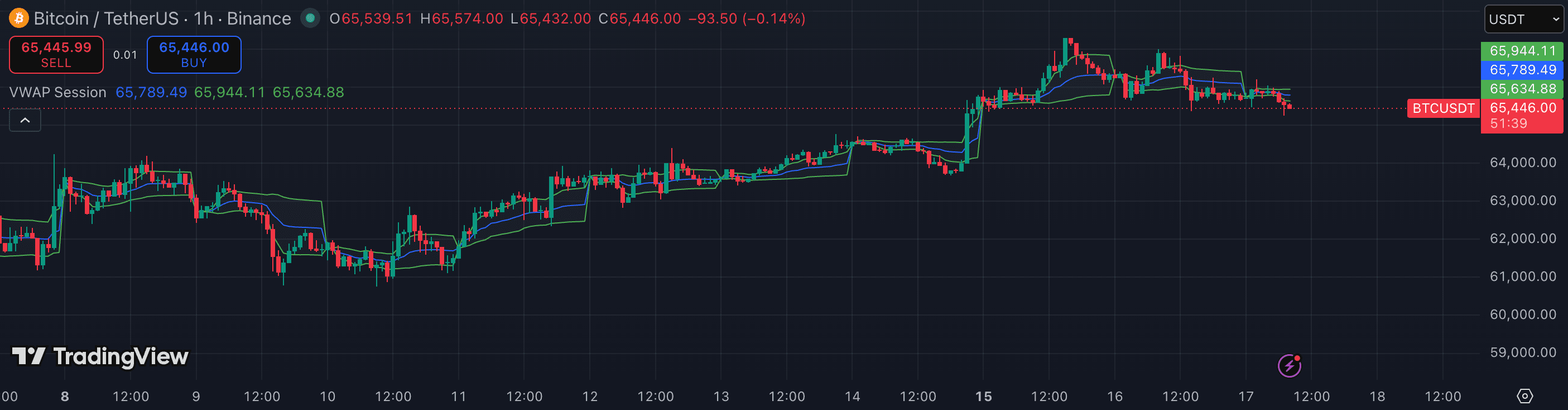
The attributes that matter.
| Attribute | Pivot Points | VWAP |
|---|---|---|
| Category | Structure | Volume |
| Basis | Prior session H/L/C math | Volume-weighted average price |
| Update frequency | Daily (static for the session) | Continuous (live) |
| Best timeframe | 5m · 15m · 1h | 1m · 5m · 15m · 1h |
| Volume awareness | None | Core to the calculation |
| Number of levels | Seven (PP + S1–S3 + R1–R3) | One anchor line (+ optional bands) |
| Best for | Session targets & price-reaction zones | Intraday bias & fair-value reference |
| Worst in | Low-volume crypto pairs | Outside the session (resets) |
Which should you choose?
Pivot Points are forward-looking price targets: they tell you where reactions are likely before price gets there, and because many participants watch the same levels, they can be self-fulfilling at R1/S1. They are purely mathematical — no volume, no market context, just prior session geometry.
VWAP is live context: it updates every bar and reflects where the actual volume-weighted cost sits right now. A reclaim or rejection of VWAP is a higher-participation event than a Pivot Point touch because it tells you something about who is winning on the day.
The best day-trading setups combine both: use VWAP for directional bias (is price above or below the session average?) and Pivot Points for specific reaction targets. A Pivot Point that aligns with VWAP becomes a high-conviction zone.
- You want pre-calculated S/R levels plotted before the session opens
- You use multiple target levels (R1, R2) to plan partial exits
- You trade a rule-based system that needs static reference points
- You want a live, volume-driven bias read for the day
- You trade intraday momentum around institutional cost benchmarks
- You use Anchored VWAP from major swing points or events
Other comparisons
Not investment advice. PineRadar is an editorial directory — links may be affiliate. Always test indicators on a demo account.