SupertrendvsRSI
Supertrend rides trends; RSI reads exhaustion. They operate on different market dimensions — which means the real question is not which one to use, but how to use them together without confusing their roles.
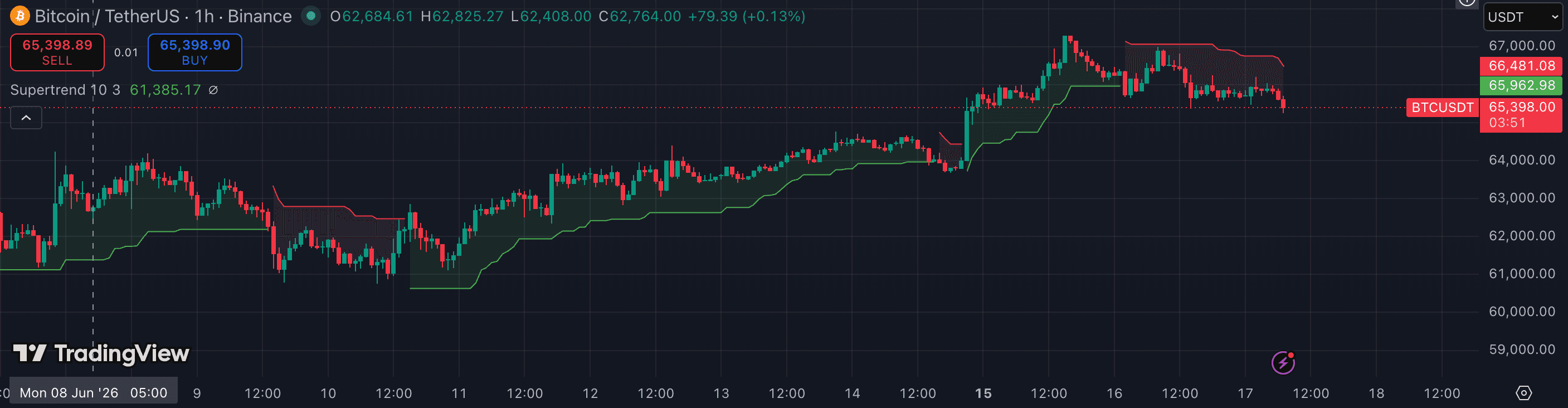
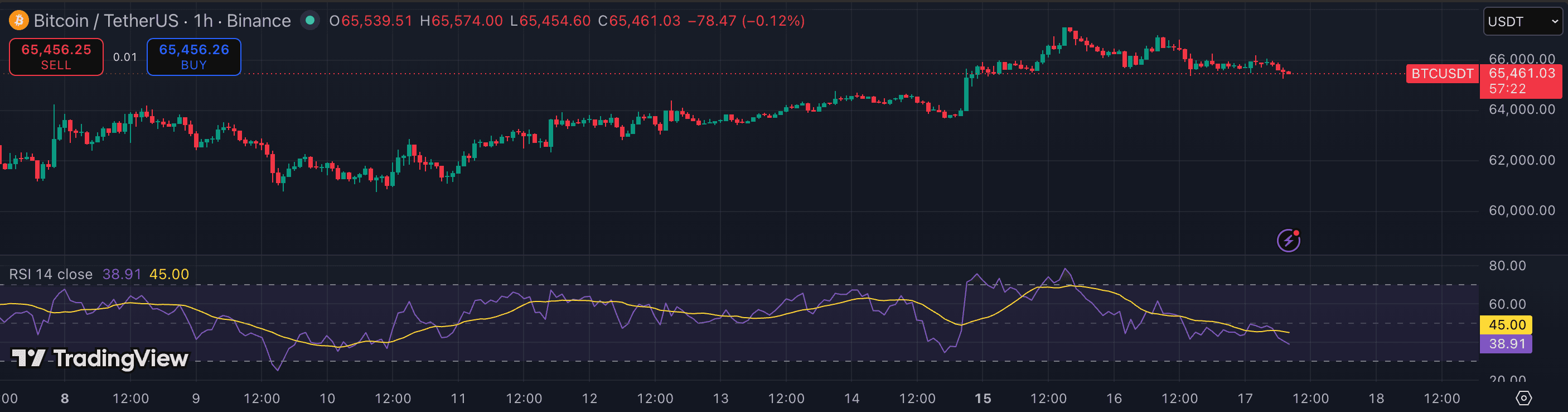
The attributes that matter.
| Attribute | Supertrend | RSI |
|---|---|---|
| Category | Trend | Momentum oscillator |
| Output | Single flipping line on price | 0–100 bounded oscillator |
| Calculation basis | ATR-based trailing band | Average gain vs average loss |
| Best timeframe | 15m · 1h · 4h | 1h · 4h |
| Range performance | Poor — whips constantly | Good — oscillates between OB/OS |
| Trend performance | Excellent — rides trend with adaptive stop | Stays overbought; divergence only |
| Divergence signals | None | Yes — reliable on majors |
| Built-in stop | Yes — ATR-based | No |
Which should you choose?
Supertrend and RSI measure completely different things. Supertrend is a binary directional tool: it is either above or below price, telling you to hold long or hold short. Its ATR basis handles crypto's volatile swings well — bands widen in choppy sessions so the line doesn't flip on every candle. What Supertrend cannot tell you is whether the move that just triggered the flip has real momentum behind it, or whether price is already running out of steam.
That is RSI's job. RSI measures momentum velocity on a 0–100 scale. In an uptrend, RSI holding above 50 confirms momentum is intact. A bearish divergence — price making higher highs while RSI makes lower highs — is an early warning that a Supertrend flip may be incoming before the line confirms it. Used together, Supertrend sets your directional bias and trailing stop while RSI tells you how much conviction to give that bias and when exhaustion is building.
- You want a clear, single trend-flip signal with an adaptive trailing stop
- You trade strong-trending crypto sessions on 15m–4h
- You prefer a binary long/short stance over a nuanced oscillator read
- You hunt reversals and want exhaustion confirmation before entering
- You trade ranging or oscillating markets where Supertrend would whip
- You want a momentum divergence signal before a trend change confirms
Other comparisons
Not investment advice. PineRadar is an editorial directory — links may be affiliate. Always test indicators on a demo account.