StochasticvsWaveTrend Oscillator
Stochastic and WaveTrend are two-line momentum oscillators commonly used to inspect turns and overextended conditions. Stochastic compares the close with its recent price range; WaveTrend smooths price-channel deviation into a slower wave. This comparison separates the transparent built-in range tool from the smoother community-script alternative. Educational content only; not financial advice.
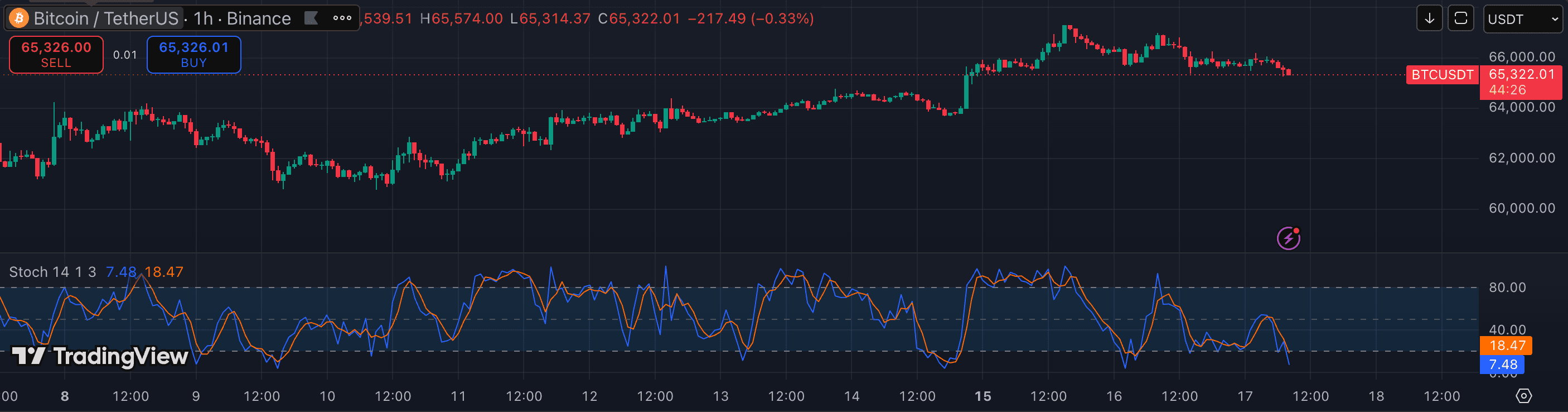
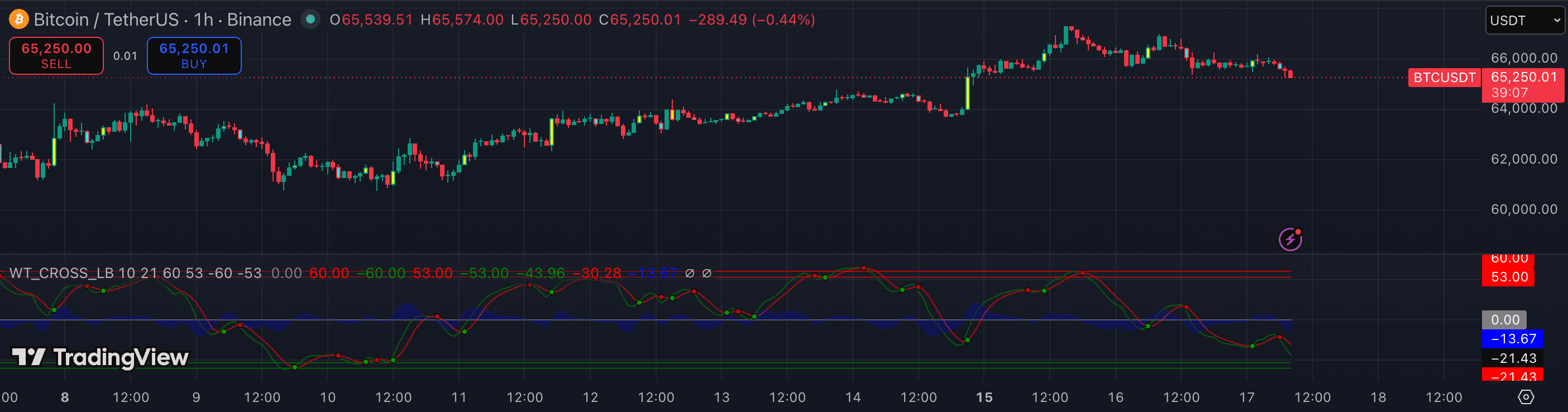
The attributes that matter.
| Attribute | Stochastic | WaveTrend Oscillator |
|---|---|---|
| Category | Momentum oscillator | Smoothed momentum oscillator |
| Calculation basis | Close relative to recent high-low range | Smoothed deviation from an HLC3 channel average |
| Output | %K + %D lines, 0–100 | WT1 + WT2 lines around a zero axis |
| Availability | Built into TradingView | Free community scripts; implementation may vary |
| Sensitivity | High — reacts quickly to range position | Moderate — additional smoothing reduces noise |
| Best timeframe | 5m · 15m · 1h | 15m · 1h |
| Best environment | Clearly defined ranges | Slower momentum swings and divergence review |
| Main limitation | Repeated counter-trend crosses in strong moves | Settings and behaviour differ across published scripts |
Which should you choose?
Stochastic is the more transparent range oscillator. Its %K line shows where the close sits within the recent high-low range, while %D smooths that reading into a crossover reference. In a clearly bounded market, that direct relationship to price makes the signal easy to audit. During a sustained directional move, however, Stochastic can remain near an extreme and produce repeated crosses that do not imply an immediate reversal.
WaveTrend trades some speed for a smoother display. Its channel-based calculation and signal line make momentum waves and divergence easier to inspect without the same volume of short-term crosses. That can suit 15m–1h crypto analysis, but WaveTrend is not a single standardised TradingView formula: community versions may use different thresholds, smoothing, or alert logic, so settings should be checked before results are compared.
For a built-in tool and a clearly defined range, Stochastic is usually the better first choice. WaveTrend is the stronger fit when you specifically want a smoother momentum cycle and divergence-oriented workflow on 15m–1h. Neither oscillator identifies the market regime on its own, so price structure or a separate trend filter should provide the context for interpreting either one.
- You want a built-in oscillator with a transparent price-range calculation
- You analyse clearly defined ranges on 5m–1h
- You prefer a faster %K/%D crossover and can filter strong trends
- You want smoother momentum waves with fewer short-term crosses
- You focus on divergence and momentum cycles on 15m–1h
- You are willing to verify the settings of the community script you use
Other comparisons
Not investment advice. PineRadar is an editorial directory — links may be affiliate. Always test indicators on a demo account.