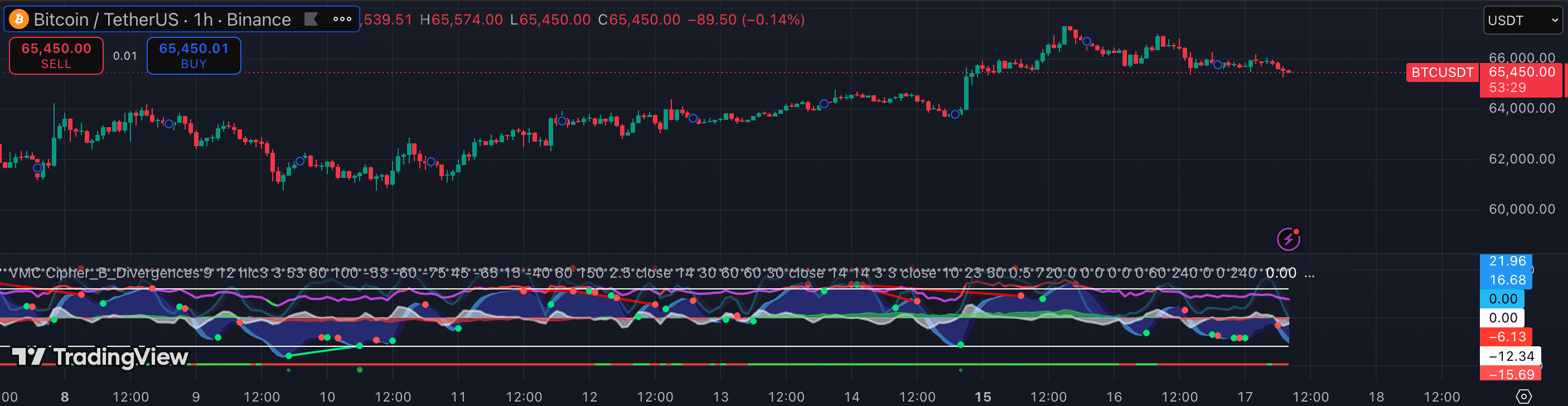
VuManChu Cipher B is a phenomenon in crypto circles: a single pane that stacks a momentum wave, money-flow shading and divergence dots. It looks like a signal machine, which is exactly the trap. Here's what each part means and how to use it as confluence.
1. Understand the three layers
The blue/dark WaveTrend wave is momentum — its crosses are the core event. The yellow dots flag potential divergence. The green/red area is money flow: green = buy pressure, red = sell pressure.
Cipher B isn't one signal; it's three reads on one screen. The edge is when they agree.
2. Trade the wavetrend cross at extremes
The highest-quality event is a WaveTrend cross near the top or bottom of its range — a green dot at the lows, a red dot at the highs. Mid-range crosses are noise.
Filter further: only take crosses where money flow is already shifting in your direction.
3. Use it for confirmation, not direction
Cipher B doesn't know your trend. Pair it with market structure or a higher-timeframe bias, and use the dots to time entries in that direction — not to pick tops and bottoms blindly.
- Taking every green/red dot as a buy/sell — most are mid-range noise.
- Ignoring money flow and trading the wave in isolation.
- Using it counter-trend to call tops and bottoms without structure.
- Stacking it with three other oscillators that say the same thing.