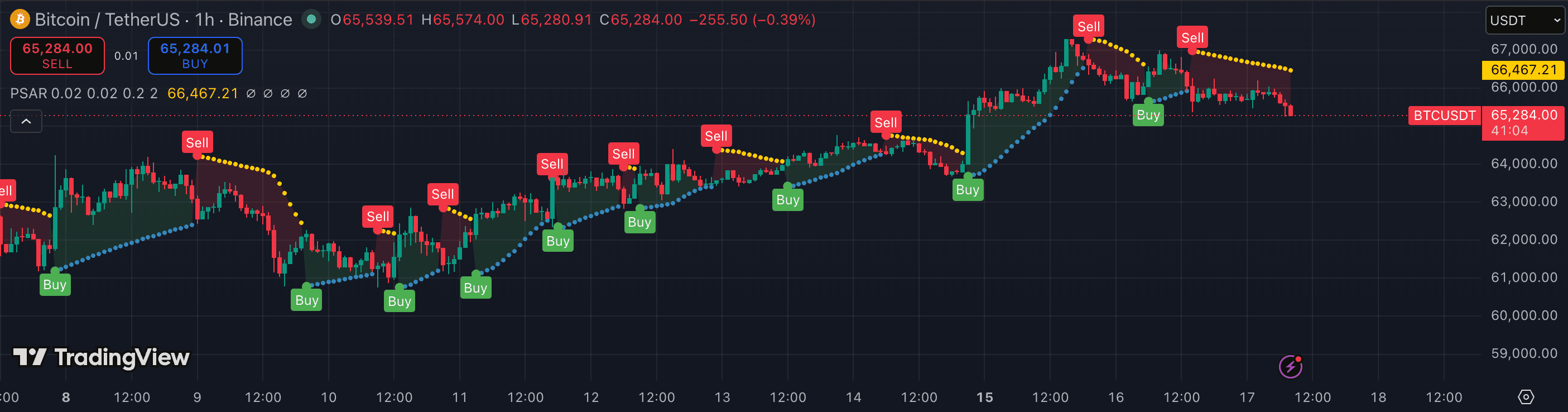
Parabolic SAR is deceptively simple — two parameters govern everything. The defaults (step 0.02, max 0.2) were designed for slower equity markets and tend to whipsaw badly on volatile crypto pairs. Here's how to tune them for different crypto trading styles.
1. Understand what the two parameters actually do
The 'Step' (acceleration factor increment) controls how quickly the SAR dots trail price as a trend extends. A smaller step starts slow and accelerates gradually — more room for normal retracements. A larger step is aggressive and will flip on minor pullbacks.
The 'Max' (maximum acceleration factor) caps how tight the trailing stop can get. Lower max = the stop never chases price too aggressively even in a runaway move. Higher max = the stop can get very tight near the end of a trend.
2. Choose your starting preset by market type
For major crypto pairs (BTC, ETH) on 1h–4h: use Step 0.01, Max 0.1. This is roughly half the default sensitivity and dramatically reduces the whipsaw on crypto's larger intraday ranges. You stay in more of each trend leg.
For altcoins or more volatile pairs on the same timeframes: Step 0.015, Max 0.1 is a reasonable middle ground — still gentler than the default but not so loose that the stop trails far behind a failed breakout.
For daily chart position trading: the standard 0.02 / 0.2 defaults work acceptably because you're not fighting intraday noise.
3. Treat SAR as a stop tool, not an entry tool
The most reliable way to use Parabolic SAR is as a trailing exit, not a trade trigger. When a flip occurs, do not immediately enter the new direction — wait for confirmation from price structure or a momentum read. SAR tells you the prior trend has weakened; it does not tell you the new one has started.
For entries, wait for price to spend at least 2–3 bars on the correct side of SAR before treating the flip as a signal. This alone cuts most of the failed reversals in ranging markets.
4. Filter with ADX to avoid range whipsaw
Parabolic SAR's worst performance is in low-ADX (below 20–25) environments. Add the ADX indicator and only use SAR signals when ADX is rising and above 20. In a flat or declining ADX environment, ignore SAR flips entirely and wait for a trend to develop.
- Using the 0.02/0.2 defaults on 1h crypto charts — this timeframe exposes every wick to a premature flip.
- Entering immediately on every SAR flip — use SAR for stops, then wait for structural confirmation before adding a new position.
- Running SAR in a low-ADX, sideways market — it will whipsaw every few bars and accumulate losses on transaction costs alone.
- Setting Max too high (0.3+) — near the end of a trend the dots chase price too aggressively and you get stopped out before the trend actually ends.