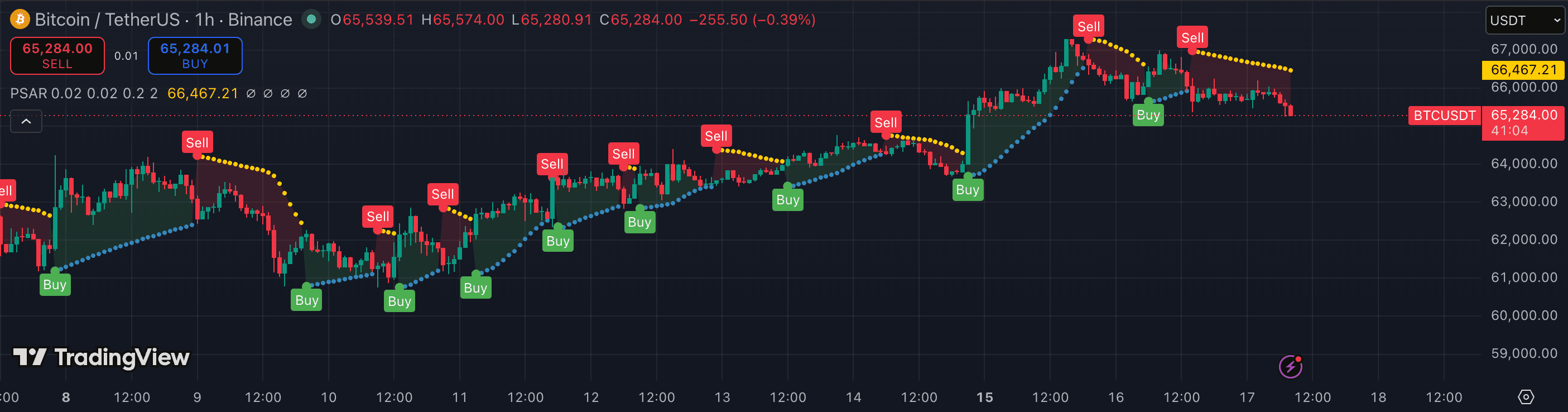
Parabolic SAR (Stop and Reverse) plots a series of dots below price in an uptrend and above price in a downtrend. When the dots flip sides, the trend has reversed — and the position reverses with it. The built-in acceleration factor is what sets SAR apart from a plain trailing stop: as the trend extends, the dots move progressively closer to price, locking in gains faster the longer the move runs. On crypto, that acceleration is both its edge in smooth trends and its weakness in choppy ones. This guide shows you how to use it correctly.
1. Understand the acceleration factor
Parabolic SAR has two settings: the initial acceleration factor (AF) and the maximum AF. The default is AF 0.02, maximum 0.20. Each time price makes a new high (in an uptrend), the AF increments by 0.02 — so the dots accelerate toward price the longer the trend runs. When the dots catch up to price and price closes through them, the trend flips.
A lower initial AF (e.g. 0.01) makes the dots start further from price and accelerate more slowly — fewer flips, but more room for the trade to breathe. A higher AF (e.g. 0.03–0.04) accelerates faster and locks in gains quicker at the cost of more frequent stops in normal volatility.
2. Use it as a trailing stop, not just a signal
Parabolic SAR's primary job in a live trade is as a dynamic trailing stop. Once you're in a position based on another signal (a Supertrend flip, a MACD cross, an order block entry), plot the SAR and use the dot level as your stop for each bar close. As the trend extends, the stop tightens automatically — you capture more profit as the move matures.
This is a more disciplined use than trading every SAR flip as an entry signal. SAR flips alone generate too many false signals in ranging crypto markets to be reliable as standalone entries.
3. Filter for trending conditions before trading flips
Parabolic SAR's biggest weakness is in sideways markets: price oscillates around the dots repeatedly, and the SAR flips back and forth generating losses on each reversal. The fix is a trend filter.
The simplest filter: only act on SAR flips when ADX is above 20–25, confirming a trend is actually present. Alternatively, only trade SAR flips in the direction of the higher-timeframe trend (Supertrend on 4h, MACD zero line on 1D). SAR flip against the higher-timeframe trend is a warning to tighten stops, not a counter-trend entry.
4. Use SAR on higher timeframes for cleaner flips
On 1m–5m charts, SAR dots flip constantly in normal market noise — the acceleration factor was not designed for the volatility density of very low timeframes. On 1h and above, the dots have more room to breathe and the flips carry more structural meaning.
A common approach: run Parabolic SAR on 1h or 4h to establish trend direction (is price above or below the dots?), then use a lower-timeframe tool (RSI pullback, Stochastic oversold cross) for entry timing within that direction. SAR defines the bias; the entry tool gives the precise trigger.
5. Compare with Supertrend — they solve the same problem differently
Parabolic SAR and Supertrend are both trailing trend systems, but Supertrend's ATR-based bands handle crypto's variable volatility better. Supertrend widens automatically in volatile stretches and narrows in quiet ones; Parabolic SAR uses a fixed acceleration factor that does not adapt to volatility at all.
In smooth, low-noise trends, SAR's accelerating dots lock in profits faster than Supertrend. In choppy or high-volatility conditions, Supertrend absorbs more noise. The two tools are genuinely complementary: SAR for the trailing stop in a clean trending move; Supertrend as the primary trend filter.
- Trading every SAR dot flip as a reversal entry — in ranges, the dots flip constantly and each reversal loses a little to spread and slippage.
- Using Parabolic SAR on 1m–5m charts where volatility noise produces constant flips with no structural meaning.
- Ignoring the trend filter — SAR without ADX or a higher-timeframe bias filter is one of the fastest ways to lose steadily in ranging markets.
- Using the default settings without adjusting for crypto's higher volatility — AF 0.02 may accelerate too fast on pairs with 5%+ daily ranges.
- Treating the first SAR flip in a new direction as a high-confidence signal — require a candle close through the SAR level, not just an intrabar touch.