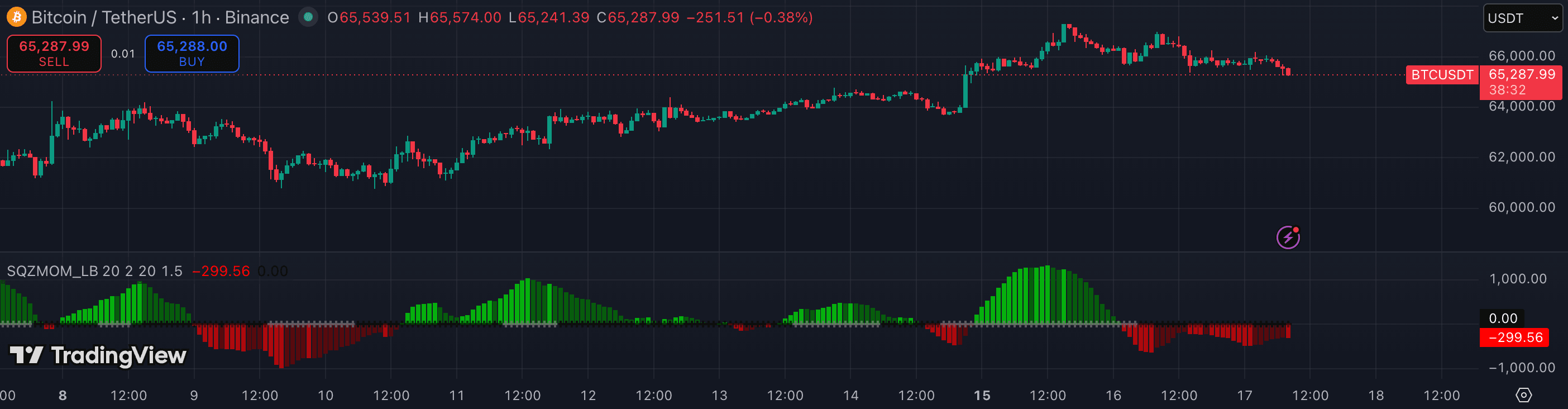
Squeeze Momentum was built by LazyBear for identifying when volatility compresses and momentum is about to burst in a direction. On higher timeframes that logic works cleanly. On scalping timeframes (1m–15m), noise increases dramatically — which means you need a stricter setup filter, a bias from a higher timeframe, and tighter execution rules to make the indicator actionable.
1. Set your bias on the 1h or 4h chart first
Scalping against the trend is one of the fastest ways to give back gains. Before dropping to your entry timeframe, check the 1h Squeeze Momentum histogram. If the histogram is positive and rising, your scalp bias is long. If negative and falling, bias short. Neutral or flat histograms on the 1h mean the higher timeframe has no clear momentum — skip the session or trade smaller.
This top-down step alone eliminates a large portion of low-quality scalp setups. The squeeze on a 5m chart is far more reliable when it fires in the same direction as the 1h histogram trend.
2. Wait for the red dots (active squeeze) on your entry timeframe
On the 5m or 15m chart, wait until Squeeze Momentum shows red dots — meaning Bollinger Bands have contracted inside Keltner Channels. This is the compression state. Do not trade during this phase; it is the setup phase, not the entry phase.
A squeeze that lasts 5–10 bars is more meaningful than one lasting 1–2 bars. Short squeezes on very low timeframes can resolve as false starts. Look for the histogram to build during the compression — bars growing in the direction of your 1h bias signal that momentum is loading, not just noise.
3. Enter when the dots turn gray (squeeze fires) with momentum alignment
The entry trigger is the transition from red to gray dots. At that moment, the Bollinger Bands have re-expanded outside the Keltner Channels, confirming the compression has released. The histogram direction at that point tells you which way the energy is pointing.
Enter long when: dots turn gray + histogram is positive (above zero) + 1h bias is long. Enter short when: dots turn gray + histogram is negative (below zero) + 1h bias is short. Avoid entries where the histogram is near zero or switching direction at the release — those setups have no momentum conviction.
4. Place stops and targets using ATR, not fixed pips
Crypto scalp volatility varies wildly by session and asset. A fixed-pip stop that works on BTC may be too tight for a mid-cap alt. Use ATR (14-period, same timeframe as your entry chart) to set stops: 1.0–1.5× ATR below entry for longs, above entry for shorts.
Target a minimum 1.5:1 reward-to-risk ratio. Given that scalp setups have shorter duration, aim to take at least partial profit at 1× ATR from entry, then let the remainder run to the next significant level (prior swing high/low, VWAP, or round number).
5. Exit when momentum stalls — do not wait for reversal confirmation
On scalp timeframes, waiting for a full reversal signal before exiting costs too much of the move. Exit or reduce your position when the histogram starts flattening or ticking the wrong direction, even if the dots remain gray. Momentum stalling is the early warning; a full crossover in the wrong direction often arrives after price has already reversed significantly.
Set a hard time-stop rule: if price has not moved meaningfully in your direction within 3–5 bars of entry, exit and reassess. Squeeze Momentum setups that don't move quickly often mean the energy was absorbed — not worth holding through.
- Scalping on 1m or 2m charts with Squeeze Momentum — noise at that resolution makes nearly every signal unreliable; minimum recommended timeframe is 5m.
- Entering during the squeeze (red dots) instead of waiting for the release — the squeeze is the setup phase, not the entry signal.
- Trading without a higher-timeframe bias — scalping counter-trend squeeze fires has a much lower expected win rate.
- Holding through a momentum stall waiting for a 'proper' exit signal — on scalp timeframes, a stalling histogram is the exit signal.
- Using Squeeze Momentum alone without an ATR-based stop — fixed stops are mis-sized relative to actual crypto volatility and result in premature exits or excessive losses.