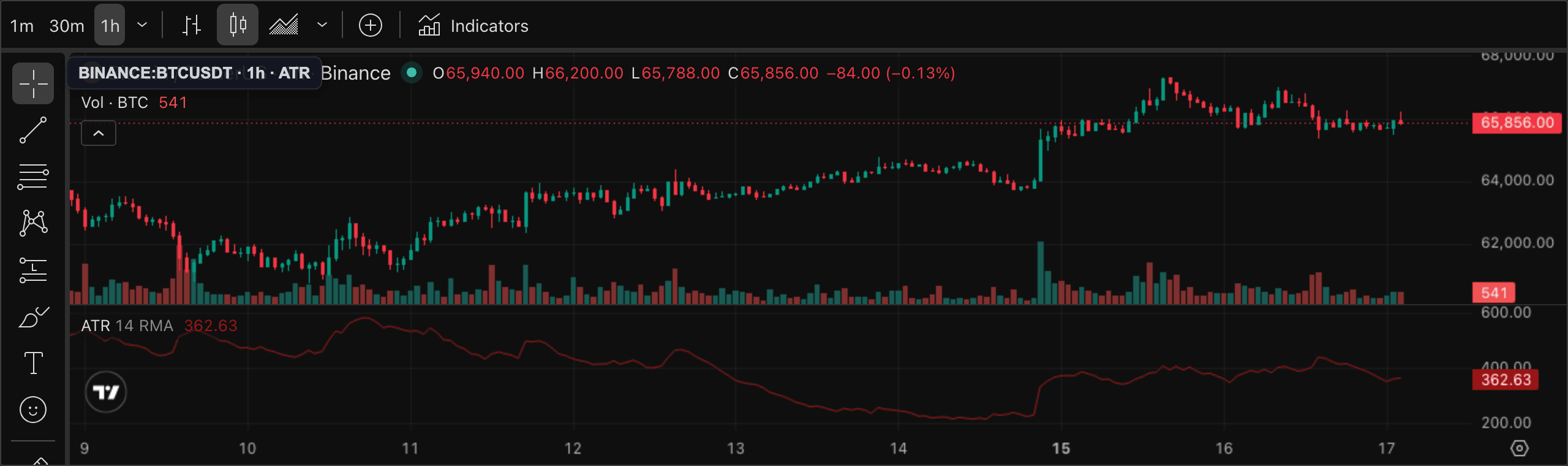
ATR (Average True Range) measures market volatility by averaging the true range of price over a lookback period. It does not tell you direction — only how much the market is moving. In crypto, where daily ranges on BTC can swing from 1% to 8%+, ATR is one of the most practical indicators for setting stops and sizing positions without relying on arbitrary fixed numbers. The default settings are a reasonable starting point, but they were designed for equity markets — crypto's faster pace and heavier volatility demand a closer look. This guide is for educational purposes only and does not constitute investment advice.
1. Understand what ATR actually calculates
ATR is the 14-period (default) exponential moving average of the true range. True range is the largest of: high minus low, high minus previous close, or low minus previous close. The previous-close component means ATR captures overnight gaps and crypto's 24/7 price jumps — making it more accurate than a simple high-minus-low on digital assets.
The output is a price value, not a percentage. If BTC ATR(14) on the 4h chart reads 800, that means BTC moved an average of $800 per 4h bar over the last 14 bars. This raw number is what makes ATR useful: it gives you a concrete dollar (or coin unit) measure of recent market movement.
2. Choose the right period for your timeframe
The default period 14 is a solid baseline, but the 'best' setting depends on what you're using ATR for. A shorter period (7–10) reacts faster to volatility spikes and is better for scalping or short-term stop placement — it captures the most recent volatility regime. A longer period (20–21) smooths out spikes and gives a more stable average, which is better for swing traders who want to set stops that survive intraday noise.
On crypto, ATR(10) on the 1h chart is a popular choice among day traders because it captures roughly the last 10 hours of volatility — enough context without over-smoothing the fast price swings common in altcoin markets.
3. Use ATR multiples for stop placement
The most practical application of ATR in crypto is the ATR-based stop. Instead of placing a stop 1% below entry — which ignores whether the market is in a low or high volatility regime — you place a stop 1.5× or 2× ATR below the entry. This means your stop automatically widens in volatile markets (so you're not stopped out by normal noise) and tightens in calm markets (so you're not overexposed).
A common starting point: use 1.5× ATR for scalping and tight setups, 2× ATR for day trading, and 2.5–3× ATR for swing trades on 4h or daily charts. These are starting points — adjust based on your own backtesting and risk tolerance.
4. Apply ATR as a volatility filter
ATR is also useful as a filter to avoid entering trades when the market is abnormally quiet or abnormally explosive. If ATR is at a multi-week low, the market may be compressing before a breakout — but low-ATR environments often produce fakeouts and choppy price action that can trap scalpers. If ATR is at a multi-week high after a spike, mean-reversion trades become riskier because volatility may remain elevated.
One practical filter: compare the current ATR to a 50-period simple moving average of ATR. If current ATR is above the MA, the market is in an above-average volatility regime — widen stops accordingly or reduce position size.
5. Pair ATR with a directional indicator
ATR tells you how volatile the market is — not which direction to trade. Always pair it with a directional tool such as Supertrend, MACD, or a moving average crossover for entry signals. ATR then plays the risk-management role: sizing your stop and scaling your position around the directional signal.
A common and effective combination is Supertrend (which already uses ATR internally) plus a standalone ATR reading for stop confirmation. If the Supertrend flips bullish but ATR is unusually high, you might reduce position size to account for the elevated risk environment.
- Using a fixed-percentage stop instead of ATR — a 2% stop that works in a calm market will get run constantly during a high-ATR volatility regime, and a 2% stop in a low-ATR environment is unnecessarily wide.
- Treating ATR as a directional signal — a rising ATR only means 'the market is moving more,' not 'it is going up.' ATR has no directional component whatsoever.
- Using the same ATR period across all timeframes — period 14 on a 1m chart covers 14 minutes of data, which is too noisy for meaningful volatility reads. Adjust the period to match the amount of time you want to look back.
- Ignoring the absolute ATR value when comparing across assets — ATR(14) on BTC at $60,000 reads very differently from ATR(14) on a $0.50 altcoin. Always read ATR relative to the current price level (ATR / price = ATR%) when comparing instruments.
- Setting stops at exactly 1× ATR — this is too tight in most cases. Normal price swings within a single bar can exceed 1× ATR. A 1.5–2× multiple is a more realistic buffer for most crypto day-trading setups.