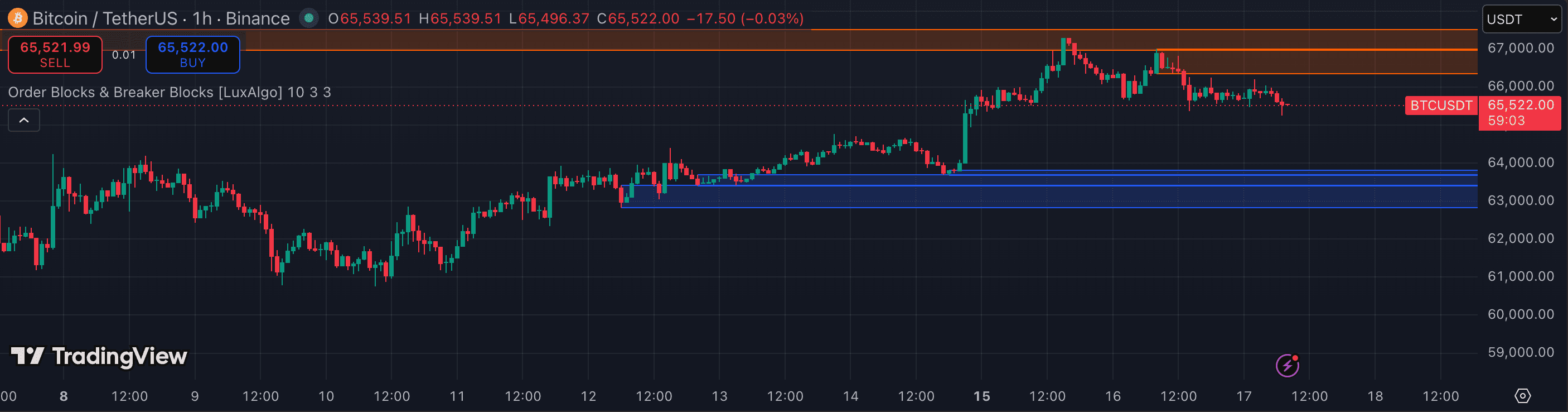
Order Blocks are a Smart Money Concepts (SMC) tool: the last opposing candle before an impulsive move marks an institutional 'order block' — a zone where price often returns. On TradingView, dedicated Order Block scripts draw these zones automatically alongside Break of Structure (BOS) and Fair Value Gap (FVG) labels. The skill is knowing which zones to trust and which to ignore.
1. Understand what an order block is
An order block is the last bearish candle before a bullish impulse, or the last bullish candle before a bearish impulse. The idea is that institutional orders were filled at that zone, and price may return to fill remaining orders.
The most actionable blocks are those followed by a Break of Structure — the impulsive move that prints a new swing high or low confirms the zone had meaningful backing.
2. Let the script filter for you
Most Order Block scripts let you display only higher-timeframe blocks, set mitigation rules (how much of the block price can enter before it's 'used'), and toggle FVG display. Start with a clean chart: show only the last three to five unmitigated blocks.
Cluttered screens with dozens of overlapping zones are a configuration problem, not a strategy. Fewer, higher-quality zones improve decision quality.
3. Combine with BOS and CHoCH for direction
An order block inside an established uptrend (confirmed by BOS prints) is a potential long re-entry zone on pullbacks. A block forming after a CHoCH (Change of Character) could be the first short opportunity in a new downtrend.
Never trade an order block against the higher-timeframe structure. The zone is only meaningful when the trend context supports the direction.
4. Time entries at the zone, not on approach
Wait for price to reach the block, then look for confirmation: a bullish engulfing, a rejection wick, or a lower-timeframe BOS from within the zone. Entering blindly on approach increases stop-hunting risk.
Place stops beyond the block's opposite edge. If the block is fully mitigated (price trades through it cleanly), treat it as invalidated.
- Trading every printed block without checking higher-timeframe structure — a block against the trend is a low-probability setup.
- Entering at the zone boundary before price arrives — wait for the zone to be tested.
- Using a script without understanding its mitigation rules — different scripts invalidate blocks differently, which affects stop placement.
- Ignoring FVGs around the block — a Fair Value Gap inside or just above/below the block often acts as the real magnet for price.
- Assuming all Order Block scripts are equivalent — quality, lookback logic, and repaint behavior vary significantly.