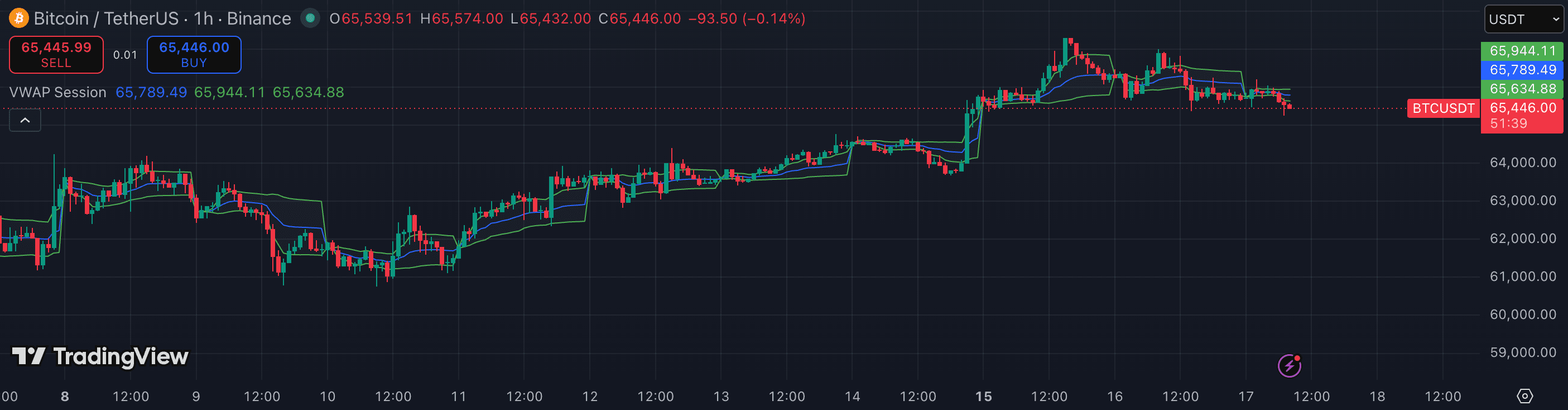
VWAP (Volume-Weighted Average Price) is the average price of all trades weighted by their volume across the trading session. It's the benchmark institutions use to evaluate fills, which is exactly why it works as a trading level: when price reaches VWAP, it reaches the average cost of everyone who traded today — and that creates a high-participation decision point. Here's how to read it and use it for crypto day trading.
1. Understand what VWAP represents
VWAP is not a moving average — it doesn't smooth price. It's a cumulative calculation that resets each session. Every bar's price is weighted by its volume, so high-volume bars pull the VWAP line harder than low-volume ones.
The implication: VWAP is most meaningful when volume is heavy. Early session VWAP (thin volume) is a rough guide; mid-session VWAP with strong participation is a high-quality level.
2. Use VWAP as a session bias filter
Price above VWAP: buyers have paid more than the session average, which is a bullish bias. Look for long setups on pullbacks to VWAP from above.
Price below VWAP: sellers dominate at the session average — bearish bias. Look for short setups on bounces to VWAP from below.
This one rule — only take longs when price is above VWAP, shorts when below — cuts a large share of counter-session trades that lose money on normal days.
3. Trade the VWAP reclaim and rejection
The cleanest VWAP trade is the reclaim: price dips to VWAP, shows a rejection candle (a wick, a bullish engulf, or a smaller-body bar), then pushes back in the trend direction. Enter on the confirmation candle with a stop below the low of the wick.
The flip side — a failed reclaim — is also tradeable: price rallies to VWAP from below, gets rejected with a bearish candle, and rolls back down. That's your short trigger for the session continuation.
4. Add Anchored VWAP from key levels
Standard VWAP resets daily. Anchored VWAP (AVWAP) lets you drop the anchor at any point — a swing high, a major low, a news candle — and track the volume-weighted average from that event forward. These AVWAP lines often become the most relevant levels on the chart.
Common anchor points: the weekly open, the last major swing high or low, a high-volume news candle. The more volume traded since the anchor, the more reliable the level.
5. Know when VWAP loses meaning
VWAP is an intraday tool. On a swing chart (4h or above) the daily reset makes VWAP irrelevant — every new session starts fresh, so the line from yesterday's session has no carry-over weight.
Also avoid relying on VWAP in dead tape (sub-average volume) — the calculation is running but very few participants are anchored to it, so the level has no participation behind it.
- Trading VWAP levels on a swing timeframe (4h+) where the daily reset makes it meaningless.
- Entering the VWAP touch without waiting for a rejection candle — price can slice straight through.
- Ignoring volume: a VWAP level in low-volume, dead-tape sessions is not a reliable decision point.
- Anchoring VWAP to random candles rather than high-significance structural events.
- Using VWAP alone with no trend or market structure context for the session bias.