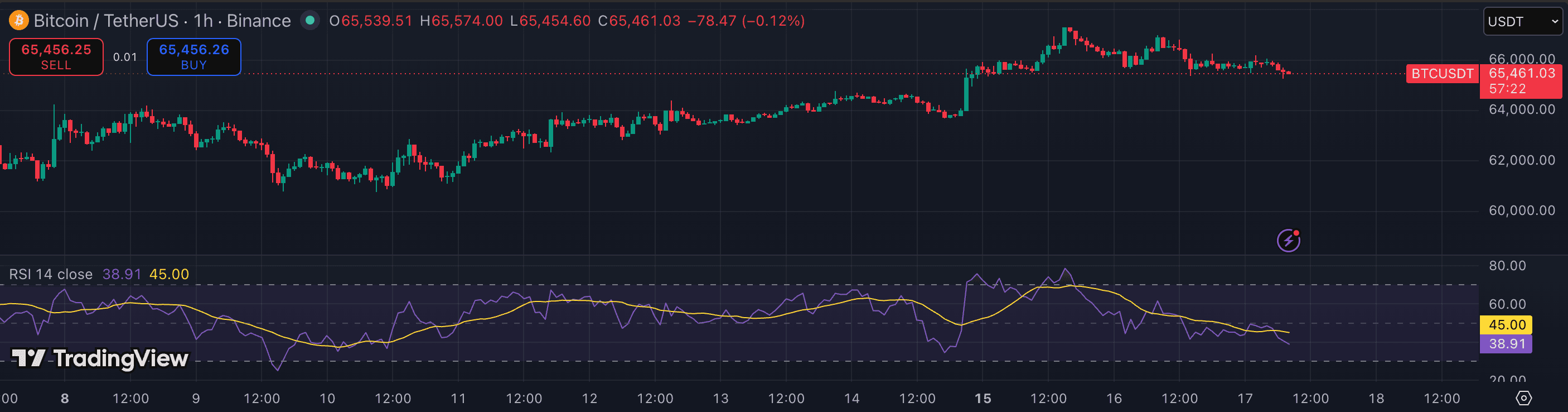
RSI ships with a 14-period length and 70/30 overbought/oversold thresholds. Those numbers work on equities in the 1970s context they were designed for. Crypto's higher volatility, 24/7 sessions, and longer trend durations mean the defaults get you into trouble if you apply them blindly. This guide maps the right RSI parameters to each timeframe and trading style.
1. Understand what the length setting controls
The RSI length determines how many bars the indicator looks back to compare average gains to average losses. A shorter length (e.g. 7–9) makes the oscillator react faster — it reaches overbought/oversold more often and gives you more signals, but also more noise. A longer length (e.g. 21–25) smooths the line and reduces false extremes, but misses fast reversals.
In crypto, fast-moving altcoins on low timeframes benefit from a shorter length. BTC and ETH on swing timeframes are better served by the default 14 or slightly longer.
2. Adjust the overbought/oversold thresholds for trend
The classic 70/30 thresholds assume mean reversion. In a strong crypto bull run, RSI can stay above 70 for days without giving a valid short signal. Raise the overbought threshold to 80 (and drop oversold to 20) when you're trading trend continuation — you'll only get signals at true exhaustion, not just mild strength.
Conversely, in sideways markets or on pairs with lower momentum, the standard 70/30 or even tighter 65/35 levels will produce cleaner signals. Adapt to the market regime, not a fixed number.
3. Use the 50 centerline as a regime filter
Regardless of your OB/OS thresholds, the 50 level tells you which side of momentum you're on. RSI consistently holding above 50 = bullish regime. Below 50 = bearish. This read is more reliable on 1h and above.
Many traders only take long setups when RSI is above 50 and short setups below — this single rule alone eliminates a large share of counter-trend losses.
4. Match the length to your entry timeframe
On scalping charts (1m–5m), use RSI length 7–9 with wide OB/OS bands (80/20) — shorter length prevents the signal from lagging, wide bands cut the constant OB/OS noise.
On day-trading charts (15m–1h), the default length 14 with 70/30 (or 75/25 in trending markets) is the right starting point.
On swing charts (4h–1D), consider length 14 or 21. Longer periods give you cleaner divergence setups because each bar represents more price action.
- Shorting because RSI hit 70 in a bull trend — in strong crypto rallies this costs you over and over.
- Using the same RSI settings across all timeframes and pairs — a 1m scalp setup does not translate to a 4h swing.
- Tweaking the length to fit historical chart view, which overfits to past data.
- Ignoring the 50 centerline and only watching OB/OS extremes, which misses the regime context.
- Taking divergence signals on RSI length 7 — the shorter the length, the lower the quality of divergence.