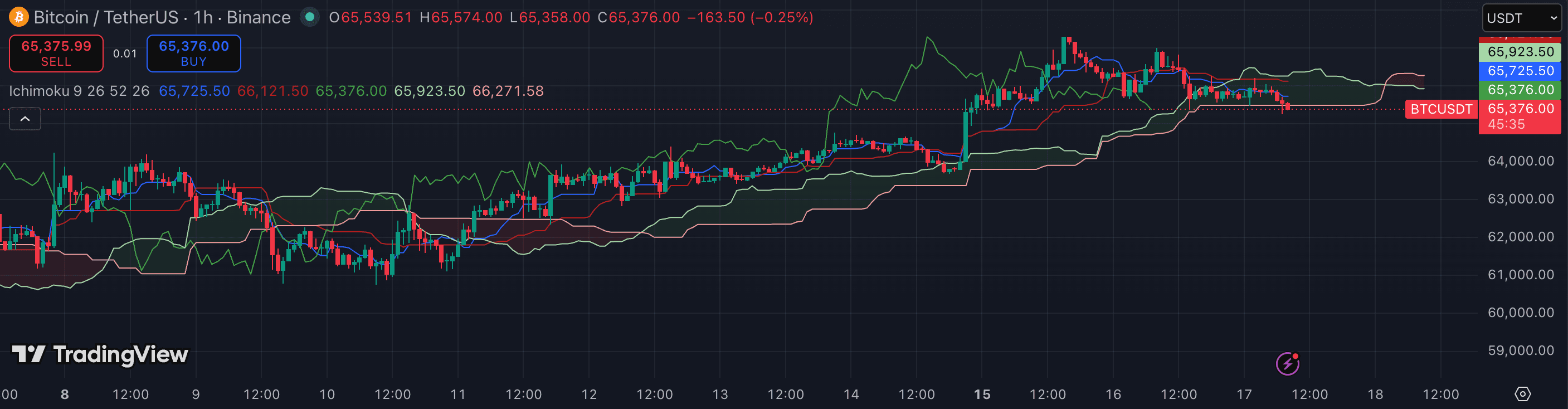
Ichimoku Cloud was designed by Goichi Hosoda for Tokyo Stock Exchange stocks, which traded six days a week. The default parameters — Tenkan 9, Kijun 26, Senkou Span B 52 — map to roughly one trading week, one month, and two months respectively in that context. On 24/7 crypto markets, those anchors shift. This guide explains the two settings approaches traders use, when each makes sense, and the settings that produce the cleanest reads on BTC, ETH, and liquid alts.
1. Understand what each parameter controls
Tenkan-sen (Conversion Line): a midpoint of the highest high and lowest low over the Tenkan period. Shorter = faster, more responsive, more whipsaw. On crypto it acts as a short-term momentum indicator — price above a rising Tenkan is bullish short-term momentum.
Kijun-sen (Base Line): same midpoint calculation over the Kijun period. This is the medium-term trend anchor. Crossovers of Tenkan above/below Kijun are the system's entry signals (TK crosses). The Kijun is also a key dynamic support/resistance level.
Senkou Span B (Cloud boundary): the longest lookback, plotted 26 periods into the future. It defines the 'back' edge of the cloud. The cloud's thickness represents the level of historical agreement between price levels — a thick cloud is stronger S/R than a thin one.
2. The crypto-adjusted settings (20-60-120)
Many crypto traders shift the settings to 20-60-120 to approximate the original weekly/monthly/bimonthly rhythm on a continuous 24/7 market. The original 26 maps to a trading month of six-day weeks; 30 calendar days on crypto is closer to 20–22 sessions but some traders use 30 to simplify. The 20-60-120 set is a principled adjustment, not an arbitrary preference.
In practice: Tenkan 20 responds to the recent three-week price cycle, Kijun 60 anchors to roughly two months, Senkou Span B 120 covers four months. On 4h charts, where each 'day' is six candles, the numbers scale differently — many 4h traders keep 9-26-52 because each bar already represents a condensed time slice.
3. When to keep the defaults (9-26-52)
The 9-26-52 defaults are not wrong for crypto — they are just calibrated differently. On 1D and 4h charts, the defaults remain widely used and widely watched, which preserves their self-fulfilling quality. When many traders are watching the same Kijun or cloud boundary, the level is more likely to produce a reaction simply because it concentrates decision-making.
If you're sharing charts with a community, collaborating on analysis, or trading a widely followed pair like BTC/USDT, consider whether deviating from defaults loses the community consensus that makes the levels meaningful. The 'best' settings are partly a function of what the market is watching.
4. Prioritise the cloud over TK crosses for crypto
TK crosses (Tenkan crossing Kijun) generate frequent signals that produce many false entries in crypto's volatile, fast-reversing environment. The stronger, more durable signals come from the cloud: price moving from below the cloud to above it (bullish Kumo breakout) or from above to below (bearish). These are higher-timeframe regime changes, not short-term entries.
The cloud's forward projection (Senkou Span A and B drawn 26 periods ahead) is what makes Ichimoku unique — it gives you a visual S/R forecast before price arrives. When approaching a projected cloud boundary from below or above, you can plan your trade before the level is reached.
5. Use Chikou Span as a confirmation filter
The Chikou Span (Lagging Span) is the current close plotted 26 periods into the past. When Chikou is above the price candles of 26 periods ago, historical momentum is bullish. When it's below, it's bearish. Use it as a confirmation gate: only enter a Kumo breakout long when Chikou is also above its corresponding historical price. If Chikou is in a cluster of price candles from 26 bars ago, the entry carries more ambiguity.
Chikou is frequently skipped by beginners as clutter. Treating it as a mandatory confirmation filter rather than a cosmetic element raises the quality of Ichimoku entries significantly.
- Trading every TK cross as an entry on 1h and below — TK crosses are frequent in volatile crypto and produce a low hit rate without a Kumo regime filter.
- Ignoring the cloud thickness — a thin cloud is weak S/R that price will likely punch through; a thick cloud is a meaningful barrier worth treating as a zone, not a line.
- Using Ichimoku on pairs with low liquidity or very short history — the 52-period Senkou Span B needs enough history to be meaningful; on a new or illiquid token, the cloud is just mathematical noise.
- Skipping the Chikou Span confirmation — treating Ichimoku as a three-component system (Tenkan, Kijun, cloud) rather than five components misses the historical context the Chikou provides.
- Changing settings constantly to make the cloud 'fit' recent price — backcurve fitting produces settings that explain past price action perfectly but fail on forward price action.