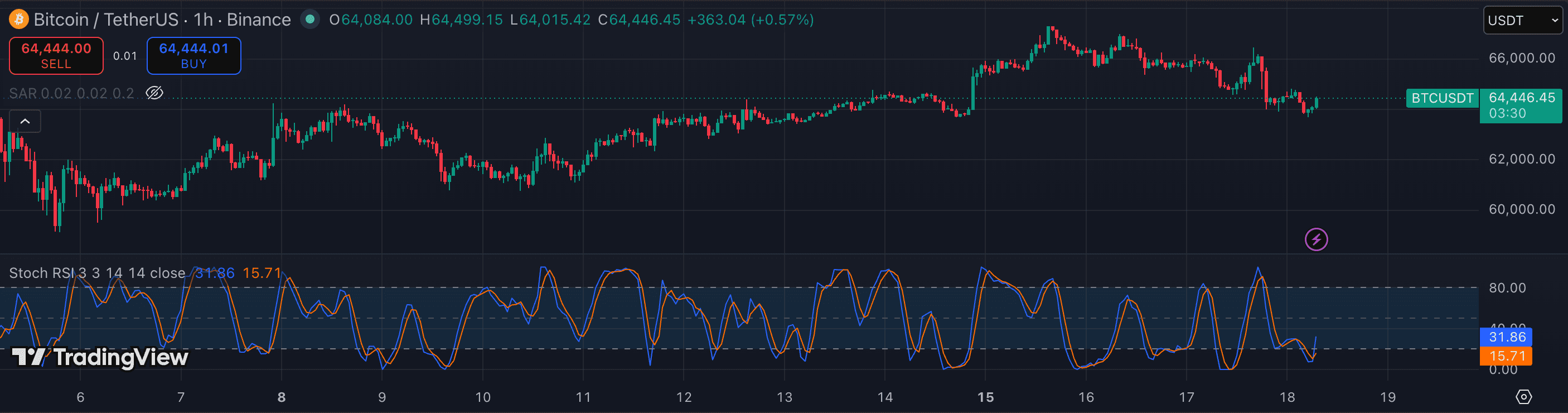
Stochastic RSI applies the Stochastic formula to RSI values, making it far more sensitive than either indicator alone. On crypto's 24/7, high-volatility market, the default 14/14/3/3 settings produce a constant stream of overbought/oversold crosses that overwhelm any filter. The right settings depend on your timeframe and style: scalpers need fast reactions with strict range filters; swing traders need heavier smoothing to eliminate noise. This guide maps the right parameters to each scenario.
1. What the four settings actually control
Stochastic RSI on TradingView has four inputs: RSI length, Stochastic length, %K smoothing, and %D smoothing. RSI length sets how many bars the underlying RSI calculation uses — longer means slower and smoother. Stochastic length sets the lookback for where the RSI value sits within its own range. %K smoothing and %D smoothing are moving averages applied to the raw Stoch output to reduce jitter.
In practice, the two numbers that matter most are the RSI length (controls overall sensitivity) and the %K/%D smoothing (controls how jagged the signal lines are). The Stochastic length matters less on crypto — most traders leave it at 14 and adjust the other three.
2. The problem with the default 14/14/3/3 on crypto
The default 14-period RSI feeding into a 14-period Stochastic with 3/3 smoothing was designed for equities on daily charts. On crypto, running these defaults on 5m–1h charts produces a line that reaches overbought and oversold multiple times per hour, making it nearly impossible to distinguish meaningful signals from noise.
On crypto, the default is genuinely too fast for swing use (where you want fewer, higher-quality signals) and creates confusion for newer traders who take every cross. The fix is different for each timeframe — not one universal adjustment.
3. Settings for scalping (1m–5m)
On very short timeframes, speed matters more than smoothing. Shorten the RSI length to 7–8 so the indicator reacts quickly to 1m–5m price action. Keep the Stochastic length at 7–10. Widen the %K/%D smoothing slightly to 3/3 (default is fine here — the shorter RSI length does the work).
Crucially: never trade Stoch RSI signals on 1m–5m without a clear ranging environment. The default overbought/oversold zones of 80/20 are correct. Only take crosses within those extremes — mid-range crosses (40–60) are noise at any timeframe, but especially at scalping speed.
4. Settings for day trading (15m–1h)
On 15m–1h, the default 14/14/3/3 is passable but still noisy. Two upgrades: first, raise the %K smoothing to 5 and %D to 5 — this produces cleaner, less jagged lines that still react within the timeframe's rhythm. Second, use it only when you have a confirmed ranging or mild-trend context on the 4h chart.
Day trading Stoch RSI signals work best as entry timers at a known price level (a VWAP reclaim, a volume profile POC, a clear support/resistance zone). The oscillator gives you the 'when'; the level gives you the 'where'. Without both, you're just reacting to every cross.
5. Settings for swing trading (4h–1D)
Swing traders need slower, higher-quality signals. Raise the RSI length to 21–25, keep Stochastic length at 14, and raise %K/%D smoothing to 5/5 or even 7/7. This produces a Stoch RSI that only reaches extremes on genuine exhaustion moves, not every minor pullback.
On 4h and above, focus exclusively on extreme-zone crosses — %K sweeping from below 20 and crossing above %D is a genuine oversold signal. Pair it with RSI divergence or a MACD histogram flip for the highest-quality swing entries. At this timeframe, one well-filtered signal per week is normal and appropriate.
- Running 14/14/3/3 defaults on 1h crypto and trading every cross — this produces dozens of signals per session, most of which are noise in trending conditions.
- Taking mid-range crosses (40–60 zone) as signals — at any Stoch RSI setting, these are the lowest-quality events and the source of most false signals.
- Using Stoch RSI without a higher-timeframe trend filter — without knowing whether you are in a trend or a range, you'll take both long and short signals and churn your account.
- Raising the RSI length past 25 on daily charts — at RSI 25+ on daily, the indicator barely moves and loses practical utility as an entry timer.
- Stacking RSI and Stoch RSI together as 'confirmation' — they measure the same underlying momentum in different scaling. Use one or the other; stacking them adds no independent information.