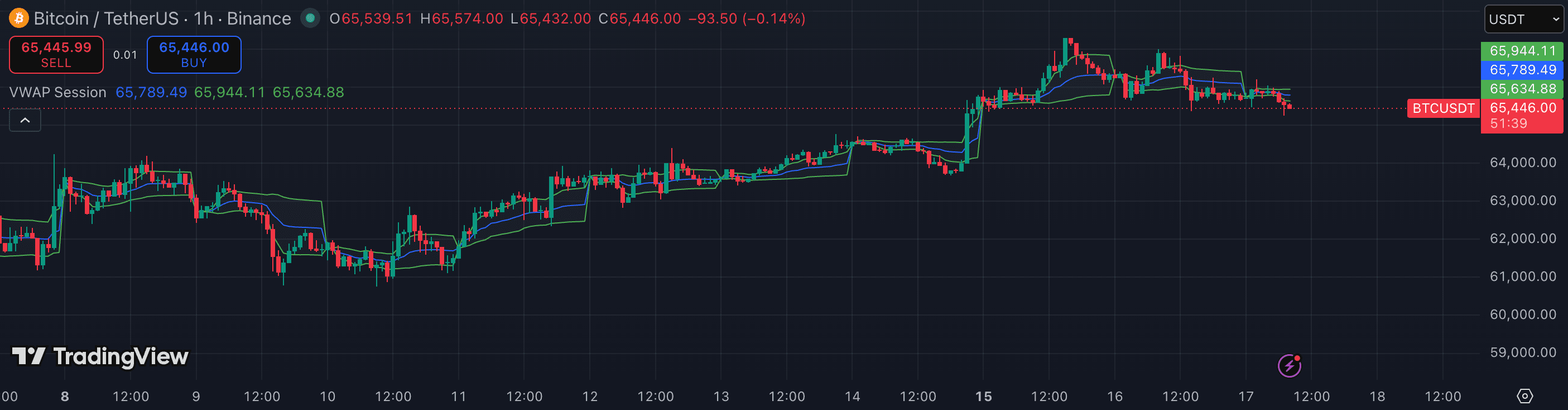
VWAP ships with essentially one meaningful choice on TradingView: how the session resets. On traditional equities, that's a non-issue — markets open at 9:30 and close at 4:00. On 24/7 crypto, the session boundary is arbitrary, which means two traders looking at 'VWAP' can be looking at completely different lines. This guide covers the right session settings for crypto, when to switch to Anchored VWAP, and how to layer the two for day-trading BTC, ETH, and alts.
1. Understand TradingView's session options for VWAP
In TradingView, the standard VWAP indicator lets you choose a session reset period: chart (resets each bar — essentially useless), session, week, month, or quarter. For crypto day trading, 'session' is the most common default, but TradingView uses a fixed 24-hour reset time (typically midnight UTC or a broker-defined cutover), not an actual exchange open.
The implication: two BTC charts with 'session' VWAP can look different depending on the data feed and timezone. Before relying on VWAP levels, check what time the line resets on your chart by looking for where the line starts from scratch — that's your effective session boundary.
2. The right session setting for crypto
For day trading crypto, 'session' reset (daily VWAP) is the standard starting point. It gives you the most-watched intraday level, resets frequently enough to stay relevant, and aligns with how most institutional desks benchmark intraday fills on Bitcoin and Ethereum.
For swing context, switch to 'week' or 'month' reset. A weekly VWAP shows you where the market's average price is since Monday — a level many crypto prop desks use to define weekly bias. Monthly VWAP maps longer-term fair value and acts as a structural S/R level on 4h and daily charts.
3. When to use Anchored VWAP instead of session VWAP
Anchored VWAP (AVWAP) is the more powerful tool. Rather than resetting on a calendar schedule, you manually drop an anchor on a significant event — a swing high, a swing low, a major news candle, the weekly open. The volume-weighted average then calculates from that anchor forward, giving you a level that reflects genuine market activity since a meaningful event.
The best anchor points for crypto: the weekly open (Monday's first bar), a significant swing high or low, or a high-volume news candle (a CPI print, a major macro event, an FTX-style contagion low). The more volume traded since the anchor, the more participants are using that VWAP level as a reference, and the stronger it becomes as S/R.
4. Layer session VWAP with a weekly anchor for context
The most effective VWAP setup on crypto is two lines simultaneously: the daily session VWAP for intraday decision-making, and a weekly AVWAP anchored to the Monday open (or the last major swing) for structural bias.
When both the daily VWAP and the weekly AVWAP sit in the same zone, that zone is exceptionally well-supported — multiple timeframes of volume-weighted activity agree. When the daily VWAP is above the weekly AVWAP and price is above both, the bias is strongly bullish. When price is below both, the path of least resistance is lower.
5. The one setting that matters most: HLC/3 source
TradingView's VWAP uses HLC/3 (high + low + close divided by three) as its default price source. This is the correct setting — it weights the entire bar's range rather than only the close, which gives a more accurate measure of where the average transaction actually occurred within each bar.
Do not change this to close-only. The HLC/3 source is the institutional standard, and matching that source means your VWAP line lands in the same place as every institutional desk running the same calculation.
- Using VWAP on 4h or daily timeframes with daily session reset — it resets every 24h and loses all structural meaning on higher timeframes. Switch to weekly or monthly reset, or use AVWAP.
- Treating the VWAP touch as an automatic reversal without waiting for a rejection candle — price can and does slice through VWAP, especially in high-momentum sessions.
- Anchoring AVWAP to random candles rather than significant structural events — an anchor is only meaningful when a large volume of subsequent trades can reference it.
- Ignoring the session reset time — on 24/7 crypto, the VWAP reset boundary varies by data feed. Always verify when your session VWAP resets before using it as a serious level.
- Adding VWAP standard deviation bands and treating them as Bollinger Bands — they measure different things and don't behave the same way. Use the line; the bands add visual noise without equivalent signal value.