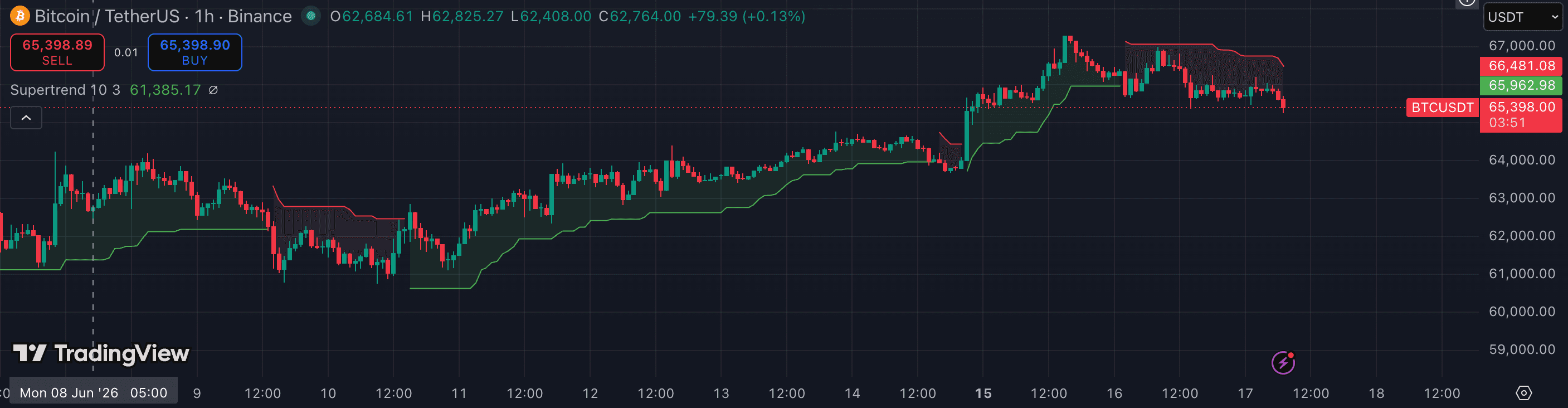
Supertrend is one of the cleanest trend tools on TradingView: a single line that sits below price in an uptrend and above it in a downtrend, flipping sides when the trend changes. It's built on ATR, which means its sensitivity automatically adjusts to current volatility — a property that makes it significantly more useful in crypto than a fixed moving average. Most traders underuse it by treating every flip as an entry signal. Here's how to use it well.
1. Understand the two settings — factor and ATR period
Supertrend has two inputs: the ATR period (how many bars it uses to calculate average volatility) and the factor (the multiplier applied to ATR to set the band distance). The default is usually ATR 10, factor 3.
A higher factor widens the band — fewer flips, slower signals, but more robust in choppy conditions. A lower factor tightens the band — more reactive, but whipsaws more in ranges. The ATR period smooths the volatility reading; a higher period reacts more slowly to sudden volatility spikes.
2. Use a higher timeframe for direction, lower for entries
Supertrend's most reliable use is as a bias filter: run it on 4h or 1D to determine whether the market is in an uptrend or downtrend. Only trade in that direction on your entry timeframe.
For example: 4h Supertrend is bullish (line below price) → only take long setups on 15m or 1h. When the 4h flips bearish, stop looking for longs entirely. This one rule cuts the majority of counter-trend losses that destroy Supertrend's expectancy for most users.
3. Use the line as a trailing stop, not just an entry trigger
Once in a trade, Supertrend's line tells you where your stop belongs — not a fixed percentage or a fixed ATR level, but an adaptive stop that follows price as the trend extends.
Move your stop to the Supertrend line value on each bar close, not intrabar. Wicks hitting the line intrabar are common in crypto and often don't represent a real trend change; a close through the line is the actual signal.
4. Filter out range conditions with ADX or volume context
Supertrend's weakness is pure ranges: when price oscillates without trending, it flips back and forth every few bars and each flip loses a small amount. The solution is to not trade Supertrend flips when the market isn't trending.
A simple filter: only trade Supertrend signals when ADX is above 20–25 (trend is present) or when the bar that triggered the flip had above-average volume. In dead, low-volume tape, stay out regardless of what Supertrend says.
5. Pair with a level for entry precision
A Supertrend flip tells you direction has changed; it doesn't tell you the optimal entry price. After a flip, wait for a pullback to VWAP, a key volume node from the Volume Profile, or a significant moving average before entering — this gives you a better risk-to-reward than chasing the flip bar.
- Taking every Supertrend flip as an entry in both directions — in a range it flips constantly and each trade loses a little.
- Using Supertrend as the only tool, without a level for entry precision or a volume filter for trend confirmation.
- Moving the stop intrabar on wick touches — wait for a bar close through the Supertrend line before acting.
- Running a low factor on a low timeframe with no higher-timeframe direction filter — this is the fastest way to churn an account.
- Ignoring the ATR: a very tight Supertrend on a low-volatility day will look clean, then whip violently when volatility returns.