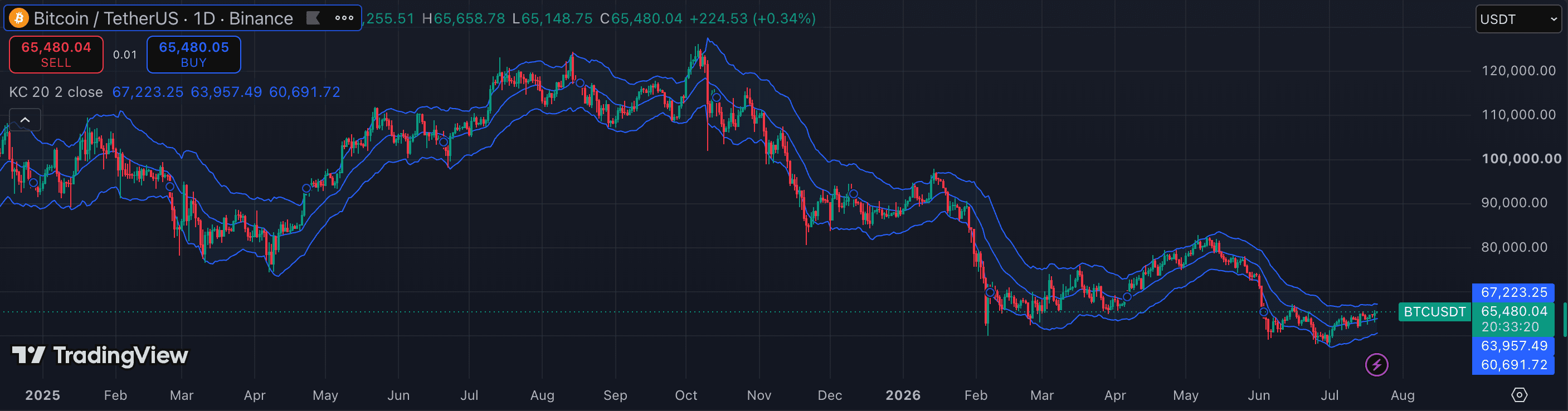
Keltner Channels wrap an EMA with bands set by a multiple of ATR. Unlike Bollinger Bands, which use standard deviation, the ATR-based width expands and contracts smoothly — which makes Keltner Channels most useful for two things: detecting squeeze setups (when BBs contract inside the KC) and timing pullback re-entries in trending markets.
1. Add the built-in indicator
Keltner Channels ship as a built-in on TradingView — search 'Keltner Channels (KC)' in the indicator library. The defaults (EMA 20, ATR multiplier 2) are a reasonable starting point for 1h–4h crypto charts.
Add Bollinger Bands (also built-in) on the same pane. The relationship between the two sets of bands is where most of the signal lives.
2. Spot the squeeze
A squeeze occurs when the Bollinger Bands contract inside the Keltner Channel — both upper and lower BB are inside the KC bounds. This indicates volatility is coiling. The squeeze itself is not directional; it signals that a significant move is pending.
When the BBs expand back outside the KC, the squeeze fires. Direction bias comes from the broader trend context, not the squeeze indicator alone.
3. Use the midline as a pullback re-entry
The middle line of the Keltner Channel is the EMA (typically 20-period). In a confirmed uptrend, pullbacks to the midline are a standard re-entry zone — price bouncing off the EMA with the channel intact signals the trend is still healthy.
Do not fade price pushing along the outer band. A market walking up the upper band in a strong trend is showing momentum, not an overextension to short.
4. Confirm breakouts
When price closes above the upper Keltner Channel band on elevated volume, that's a breakout signal worth tracking. It does not guarantee continuation — check whether volume is above average and whether higher-timeframe structure supports the move.
False breakouts are common in choppy markets. Wait for a close, not just a wick, through the band before committing.
- Using Keltner Channels in isolation without Bollinger Bands — the squeeze setup requires both, and KC alone is a weaker signal.
- Shorting every upper-band touch in a trending market — price can walk along the outer band for many candles in a strong trend.
- Taking a squeeze breakout in the direction of recent price action without checking higher-timeframe bias.
- Ignoring volume during a breakout — a band expansion on low volume has a much higher false-breakout rate.
- Over-tuning the ATR multiplier without a clear reason — start with the defaults and only adjust if the squeeze signals are consistently too early or late.