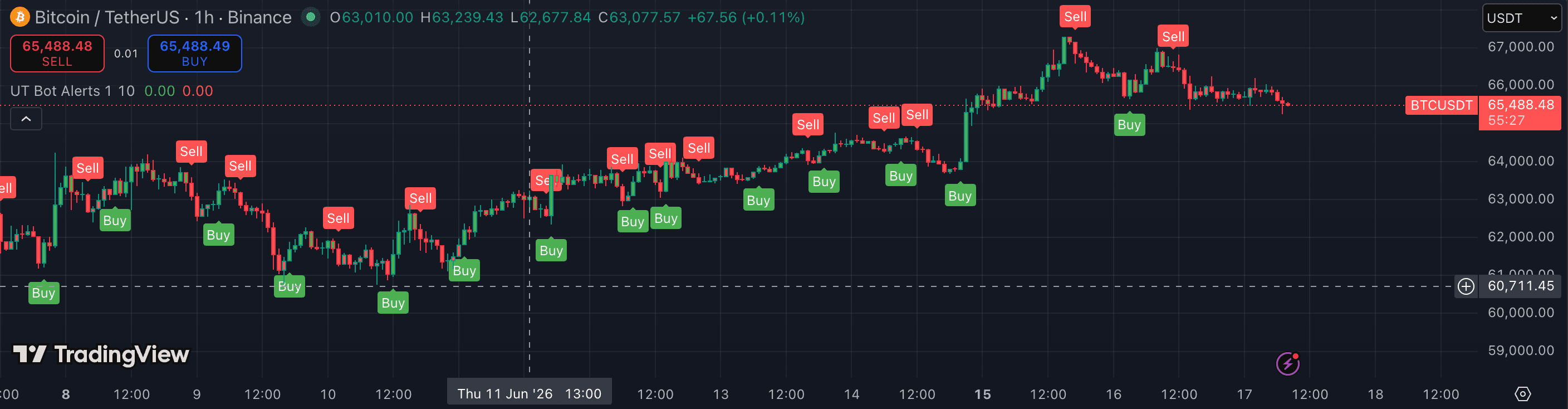
UT Bot Alerts is an ATR-based trailing-stop indicator that fires buy/sell labels with built-in alerts. Its default settings are deliberately sensitive: they catch moves quickly but generate significant noise in non-trending conditions. Adjusting the two core parameters — key value (sensitivity) and ATR period — is the difference between a signal stream worth trading and a constant stream of false triggers. This guide is for educational purposes only and does not constitute investment advice.
1. Understand the two parameters that matter
UT Bot has two primary inputs: key value (also called sensitivity factor) and ATR period. The ATR period determines how many bars of price data the trailing stop is based on — shorter periods react faster but are noisier. The key value multiplies that ATR figure: a higher key value means the trailing stop is placed further from price, so the indicator flips less often and only on larger moves.
All other UT Bot settings are secondary. Get these two right for your use case before touching anything else.
2. Defaults are aggressive — understand why before copying
The UT Bot defaults (key value 1, ATR period 10) are set for maximum sensitivity. On 1h BTC they produce frequent flips and will whipsaw in sideways conditions. Many traders copy settings from social media without understanding what they represent — higher key values cut flips but widen the trailing stop, which affects both your entry timing and your stop distance.
There is no universal 'best setting.' The right combination depends on your timeframe, the asset's volatility, and whether the market is trending or ranging.
3. Tune for scalping (1m–5m)
On low timeframes, the goal is responsiveness without constant false flips. A key value of 1.5–2 with ATR period 10 is a common starting point. Raising the key value from the default 1 to 2 roughly doubles the distance of the trailing stop from price — this keeps the indicator on the right side of the tape during micro-trends without flipping on every small pullback.
On 1m–5m BTC, test key value 2 / ATR period 10 as a baseline. On noisier alts, move to key value 2.5–3 to reduce the whipsaw rate.
4. Tune for day trading (15m–1h)
On 15m–1h, you want signals that filter session noise but still catch intraday trend flips. Key value 2–3 with ATR period 10–14 is the most widely used range. A key value of 3 with ATR period 14 on 1h BTC is a cleaner signal — it produces fewer flips that tend to align with clear market-structure shifts.
At this timeframe, UT Bot works well as a higher-timeframe bias tool: run it on 1h to get your directional stance, then look for lower-timeframe entry triggers in that direction rather than trading every 1h flip directly.
5. Tune for swing trading (4h–1D)
On higher timeframes, sensitivity becomes less important than stability. Key value 3–4 with ATR period 14 is a reasonable starting range for 4h. The trailing stop will be wider in price terms, reflecting the larger swings of a multi-day hold. On 1D, key value 3 / ATR period 14 behaves similarly to Supertrend with a factor of 3 — the two are mechanically close at that timeframe.
At the swing level, UT Bot's built-in alert functionality becomes its main advantage over similar indicators: you can set alerts and check in on key flips rather than watching the chart continuously.
6. Set alerts properly
UT Bot's alert conditions appear under 'Alert()' in TradingView's Create Alert dialog. Select 'UT Bot Alerts' as the indicator, then choose either the buy signal or sell signal condition. Set the alert frequency to 'Once per bar close' to avoid firing alerts mid-bar on a signal that may not survive the close.
Alerting on bar close rather than during the bar eliminates the most common UT Bot trap: a label that appears mid-bar and then disappears when price pulls back before close.
- Using the default key value 1 on 15m+ timeframes — it produces far too many flips to trade meaningfully and will generate alert fatigue quickly.
- Alerting on 'any alert()' or mid-bar instead of bar close — UT Bot labels can appear and disappear within a bar, so a mid-bar alert often fires on a signal that does not survive.
- Treating every UT Bot flip as an entry signal regardless of market context — in a range, even a high key value will produce flips that go nowhere. Always check whether the broader market structure supports a trend continuation before acting on a flip.
- Copying settings from screenshots without knowing the timeframe — a key value of 1 on a daily chart is very different from key value 1 on a 1m chart; the number only makes sense alongside the timeframe.
- Ignoring position sizing relative to the ATR-based stop distance — a wider trailing stop (from a higher key value) means you are accepting more price risk per trade. Scale position size down accordingly to keep total risk consistent.