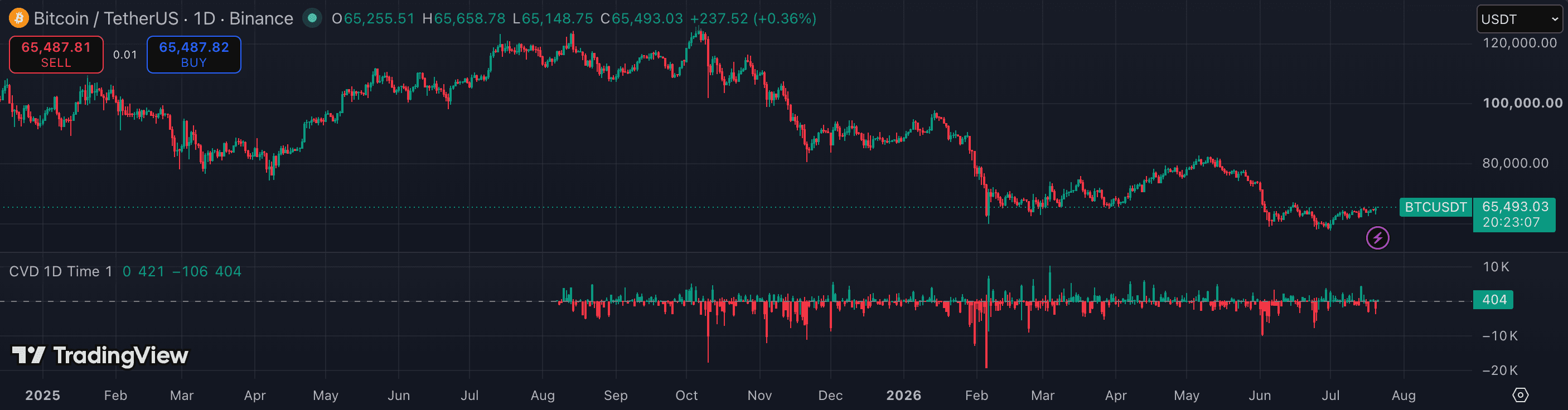
Cumulative Volume Delta is one of the few indicators in crypto that shows you what is actually happening in the order book — who is buying aggressively versus who is selling. Unlike most indicators, CVD has very few adjustable parameters, but the ones that matter (script choice, reset period, and smoothing) significantly affect what you see. This guide covers how to configure CVD correctly and, more importantly, how to read the signals it generates.
1. Choose the right CVD script on TradingView
TradingView does not have a single official CVD indicator. You need to search the community scripts for 'Cumulative Volume Delta'. The most widely used free implementation is by LonesomeTheBlue — look for 'Cumulative Volume Delta (CVD)' in the public indicator library. Some premium plans include a native Volume Delta chart type; if you have access to it, use it over community scripts as the underlying data is more accurate.
When evaluating a CVD script, check whether it uses tick-by-tick delta (more accurate, requires a premium data plan) or bar-by-bar delta (approximated from up/down volume per candle). Bar-by-bar delta is the standard on most free scripts and is accurate enough for most crypto analysis. The signal quality difference only matters on very short timeframes (1m–3m).
2. Set the reset period to match your trading timeframe
CVD accumulates delta over time, so the reset period controls how far back it looks. Most scripts offer daily, weekly, or session-based resets, or a fixed number of bars. For intraday crypto day trading on 5m–1h, reset CVD to 'Daily' so it accumulates within the current trading day. This gives you a clean picture of intraday order flow without long-term historical noise.
For swing trading on 4h–1D, extend the reset to 'Weekly' or use a fixed-bar lookback of 50–100 bars. This smooths out single-session noise and lets you see whether buying or selling pressure is building over multiple days. On 15m charts with a daily reset, you typically get 70–90 bars per day — a good window for spotting meaningful delta trends.
3. Add a smoothing EMA on CVD (optional but useful)
Raw CVD is often jagged, especially on 5m–15m charts. Adding a short EMA (period 5–9) on top of CVD helps you see the direction of delta flow without bar-by-bar noise. Many CVD scripts have a built-in smoothing toggle; if not, right-click the CVD indicator and add a Moving Average on it.
Keep the smoothing short — a long EMA (20+) will lag so much that CVD divergences resolve before the smooth line shows them. A 5–7 period EMA on 5m, or a raw CVD on 1h, is the most common setup among order flow traders.
4. Read delta divergence — the main signal
The primary CVD signal is divergence from price. When price makes a new high but CVD does not — buyers are not participating with the same aggression. This is a warning that the move may be distributed or absorbed by sellers, not driven by genuine demand. The reverse (price lower low, CVD higher low) flags buy absorption at a potential bottom.
Do not act on divergence alone. CVD divergence tells you the move lacks conviction — it does not tell you when the reversal comes or how deep it will be. Use it as a filter: tighten stops, wait for structural confirmation, or reduce size. Do not use it as a standalone short entry signal.
5. Confirm breakouts with CVD agreement
CVD is most powerful as a breakout filter. When price breaks a key level and CVD surges in the same direction, aggressive participants are driving the move — the breakout has real order flow behind it. When price breaks a level but CVD is flat or moves opposite, the breakout is likely being absorbed and has a higher chance of failing.
This CVD-breakout confirmation works best on liquid pairs (BTC, ETH, SOL) on 15m–1h. On low-volume alts, thin order books distort the delta signal and false breakouts with CVD agreement become more common.
- Using CVD on low-volume altcoins — thin order books make the delta signal unreliable; the signal quality drops sharply outside the top 10–20 crypto pairs by volume.
- Treating CVD divergence as a reversal entry rather than a caution flag — divergence can persist for many bars before resolving, and trading against a trend on CVD divergence alone is a common losing pattern.
- Running CVD with a very long reset (all-time or monthly) for intraday analysis — historical delta accumulation swamps today's signal and makes divergence unreadable.
- Stacking CVD with OBV and treating them as independent confirms — both are volume-flow reads that generally agree; they add noise, not independent edge, when used together.
- Ignoring the script's delta calculation method — bar-delta and tick-delta scripts can diverge on the same candle, especially during high-volatility sessions. Know which type you are using.