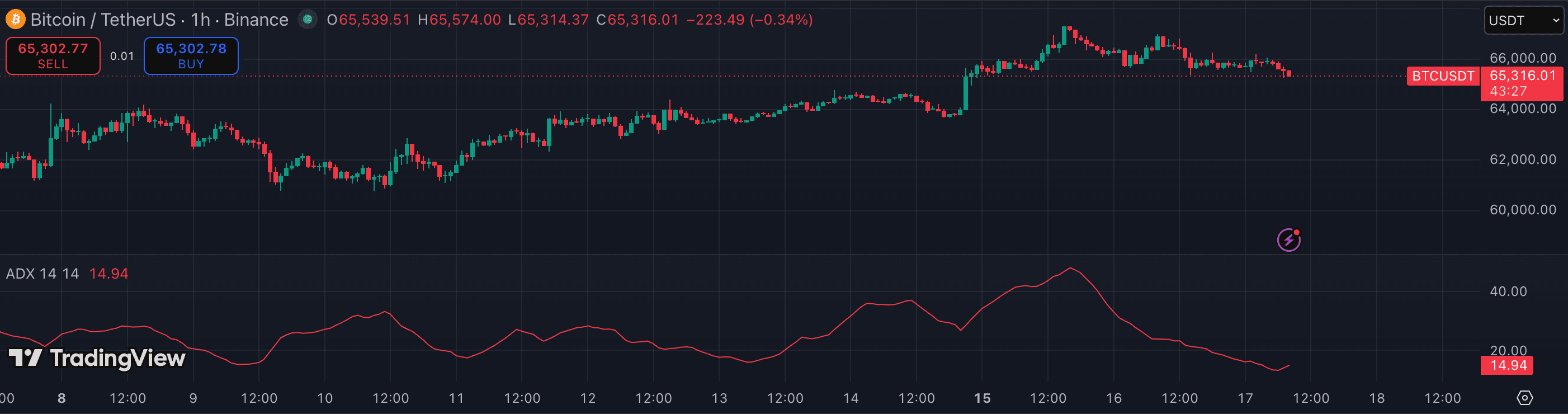
ADX (Average Directional Index) measures trend strength on a 0–100 scale, where higher readings mean a stronger trend regardless of direction. It's one of the most misunderstood indicators in technical analysis: many traders look at ADX rising and assume 'bullish signal,' not realising ADX is directionally neutral. This guide explains the settings that make ADX a useful trend filter for crypto, and how to configure it to cut chop without missing big moves.
1. Understand what ADX is actually measuring
ADX does not tell you whether the market is going up or down — it tells you whether the market is trending at all. An ADX reading of 30 means the trend is strong, whether that trend is bullish or bearish. For direction, you read the +DI and -DI lines: when +DI is above -DI, the trend is upward; when -DI is above +DI, the trend is downward.
The most common use in crypto is as a filter: only take trend-following signals (from Supertrend, EMA crosses, MACD) when ADX is above a threshold — typically 20 or 25 — which means a real trend is in place. When ADX is below 20, the market is in chop, and trend signals have much lower follow-through.
2. Keep the default period at 14 for most uses
ADX is calculated from 14 periods of smoothed +DI and -DI by default. This is Wilder's original setting and remains the most widely used, making it a reasonable baseline. The 14-period ADX on the 1h chart covers 14 hours — enough to assess whether the current price movement has genuine directional strength.
Reducing the period (e.g. to 7 or 10) makes ADX more reactive — it rises and falls faster, which can give earlier warnings of trend initiation but also produces more false readings. Increasing the period (e.g. to 20 or 21) smooths out the indicator and produces fewer but higher-confidence readings. For crypto scalping on 5m–15m, a period of 7–10 is common to avoid lag; for daily swing analysis, period 20–21 is more appropriate.
3. Set the trend threshold at 20 for crypto (not 25)
The traditional textbook threshold for 'a trend is present' is ADX above 25. In practice, many crypto markets enter and sustain directional moves with ADX readings in the 18–24 range — using 25 as the cutoff means missing the early phase of a move. For crypto, a threshold of 20 is more practical: above 20 means you're in a trending environment; above 30 means the trend has real momentum; above 40 means the move is very extended.
Conversely, ADX below 15–18 is a clear signal to stop trading trend-following strategies. When ADX is falling and below 20, ranges and mean-reversion setups (RSI divergence, Bollinger Band fades) outperform trend entries.
4. Use ADX as a filter, not a standalone signal
ADX is most valuable when combined with other indicators. A common and effective setup: use Supertrend for direction and entry signals, and only act on Supertrend flips when ADX is above 20 and rising. When ADX is falling or below 20, skip the Supertrend signal entirely — those flips in low-ADX environments are almost always false.
Similarly, filter MACD crossings with ADX. A MACD signal-line cross while ADX is rising above 20 has much higher follow-through than the same cross when ADX is below 15 and falling. The two indicators answer complementary questions: MACD asks 'is momentum shifting?' and ADX asks 'is there enough trend strength for that shift to matter?'
5. Watch ADX slope, not just level
A rising ADX is more actionable than a high ADX. When ADX is at 35 but declining, the trend is weakening — not the time to add to a position. When ADX is at 18 and rising steeply, a new trend may be starting — a better entry environment than the high-but-falling reading.
The combination of ADX level and direction gives you four market states: (1) Low and rising: potential trend beginning — watch for confirmation. (2) High and rising: strong trend in progress — trend-following setups preferred. (3) High and falling: trend exhausting — reduce size, tighten stops. (4) Low and flat or falling: clear chop — prefer mean-reversion or sit out.
- Treating ADX as directional — a rising ADX only means 'the trend is strengthening,' not 'it is going up.' Always check +DI vs -DI for direction.
- Using the same ADX threshold for all timeframes — 25 as a trigger is too strict for 15m crypto scalping and too loose for daily chart swing trading.
- Taking trades because ADX is high without checking whether it is rising or falling — a high but declining ADX means the trend is fading, not extending.
- Running ADX on very short periods (4–5) on higher timeframes — this produces an indicator that spikes on every small candle cluster rather than reflecting genuine directional strength.
- Using ADX in isolation — it tells you how strong the trend is, not whether it is safe to enter. Pair with a directional tool (Supertrend, MACD, EMA) for entry timing.