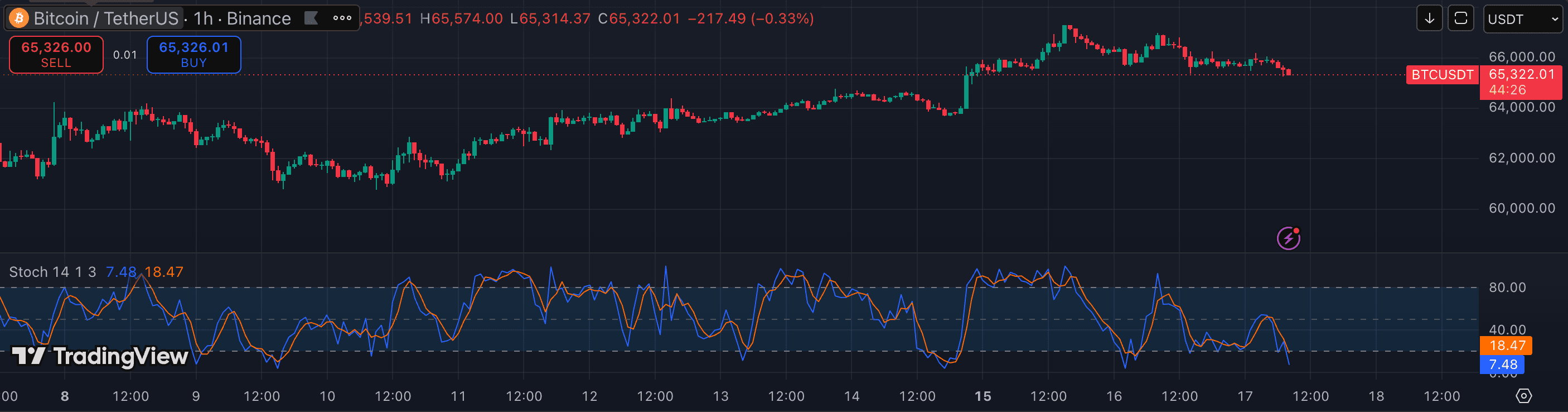
The Stochastic oscillator measures where the current close sits within a recent high-low range, normalized to 0–100. Its classic settings — 14 periods, %K smoothing 3, %D smoothing 3 — were calibrated for equity markets trading six hours a day. On crypto's 24/7 market with larger daily ranges and faster momentum shifts, those defaults create noisy signals in ranging conditions and sluggish responses during fast trends. This guide explains what each setting controls and which configurations work best for different crypto trading styles. This content is for educational purposes only and does not constitute investment advice.
1. What the three Stochastic settings control
Stochastic on TradingView has three main inputs: %K length (the lookback period), %K smoothing (how much to smooth the raw %K line), and %D smoothing (the moving average of %K, which becomes the signal line). A longer %K length makes the indicator slower and catches only larger price cycles. Higher smoothing values reduce noise but add lag.
On crypto, the most impactful adjustment is %K length. A period of 14 means the oscillator looks back at 14 bars to define the recent high-low range. On a 15m chart, that is 3.5 hours of price action; on a daily chart, 14 bars is two weeks. The period controls how 'wide' the context window is — not the indicator's speed alone.
2. The problem with 14/3/3 defaults on crypto
The classic 14/3/3 setting on lower crypto timeframes (5m–1h) produces a %K line that oscillates between overbought and oversold multiple times per hour during active sessions. In a strong Bitcoin uptrend, Stochastic stays pinned near 80 for hours — not because the setup is overbought in any meaningful sense, but because momentum is overriding the oscillator's range assumption.
For crypto scalpers and intraday traders, the default period is too long: it lags actual price action by the time %K crosses %D, the move is already underway. For swing traders on 4h and daily charts, the opposite problem emerges — 14 bars is too short to define a meaningful price extreme, and the indicator crosses back and forth through the midpoint constantly.
3. Settings for scalping (1m–5m)
On very short timeframes, reduce %K length to 5–8 so the oscillator captures intrabar momentum, not the broader session range. Use %K smoothing of 2–3 and %D smoothing of 2–3 to keep response fast. The key discipline at this speed: only take signals when %K is actually at an extreme (above 80 or below 20) and crosses %D in the opposite direction — mid-range crosses are almost always noise.
On 1m–5m scalps, Stochastic works best in clearly ranging conditions. During strong trend candles, Stochastic will pin near 80 or 20 for extended periods — this is correct behavior, not a failure. Wait for a confirmed pause or pullback before using the oscillator for entry timing.
4. Settings for day trading (15m–1h)
On 15m–1h charts, the common adjustments are: lower the %K length to 9–12 (reducing lag vs the default 14), raise %K smoothing to 5 and %D smoothing to 3. This produces cleaner lines that still react within the session timeframe without being overwhelmed by tick-level noise.
For day trading crypto, Stochastic is most effective as a timing tool within a known price level — a VWAP support zone, a volume profile high-volume node, or a clear chart support. The oscillator answers the question 'is the oscillation at this level pointing toward a reversal?' — not 'should I buy here?' Use a higher-timeframe trend filter (4h EMA or MACD) to determine direction first, then use Stochastic on 15m–1h to time the entry.
5. Settings for swing trading (4h–1D)
On 4h and daily charts, the default 14/3/3 setting is reasonable but can be improved. Many swing traders extend the %K length to 21 and raise smoothing to 5/5. This eliminates the constant mid-range crossing and reserves Stochastic signals for genuine momentum extremes — places where the market has moved far enough in one direction that a reversal is structurally plausible.
At swing timeframes, the most reliable Stochastic signal is a %K/%D cross from below 20 (oversold) or above 80 (overbought), confirmed by a reversal candlestick pattern or divergence with price. Without price confirmation, Stochastic can remain at extremes for extended periods in strong crypto trends — do not treat an oversold reading alone as an entry signal.
- Trading every %K/%D cross regardless of zone — mid-range crosses (30–70) produce the most false signals. Restrict entries to crosses that originate in overbought or oversold territory.
- Using the default 14/3/3 on 5m–15m crypto without adjusting for 24/7 market structure — the settings create excessive signal frequency on short-timeframe crypto charts.
- Interpreting a sustained overbought reading as a sell signal in a trending market — in strong trends, Stochastic parks at 80+ for hours or days. The extreme reading reflects momentum, not reversal.
- Applying Stochastic to a strong trending market without a trend filter — oscillators perform best in ranging conditions; they produce losing signals when applied blindly in trending crypto markets.
- Stacking Stochastic and Stochastic RSI together as independent confirmation — both are derived from similar range-relative calculations and carry largely overlapping information.