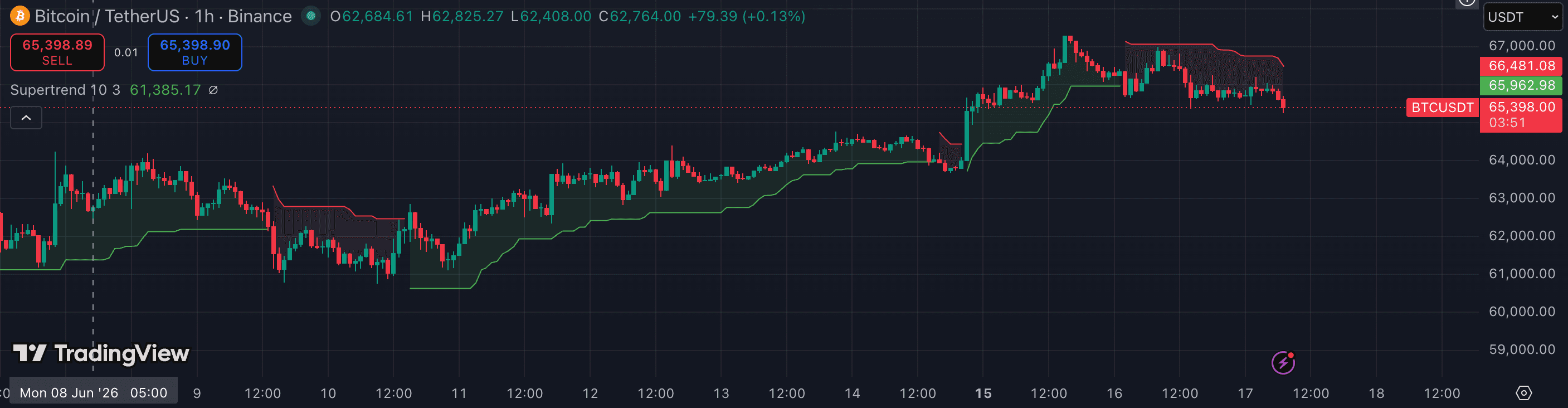
Supertrend ships with two parameters: ATR period and factor (multiplier). The default is ATR period 10 and factor 3. Those numbers hold up reasonably well across many conditions, but understanding what each setting controls lets you adapt intelligently when the default is giving you too many whipsaws in a ranging market or signals that are too slow to catch fast crypto moves. This guide maps the right Supertrend settings to each timeframe and trading style.
1. Understand what ATR period and factor actually control
The ATR period determines how many bars Supertrend uses to calculate average volatility. A longer period (e.g. 14–20) smooths out short-lived volatility spikes, keeping the band stable during news events. A shorter period (e.g. 7–10) reacts faster to changing volatility but also makes the band jump more aggressively when a single large candle appears.
The factor is the multiplier applied to ATR to set the band distance from price. A factor of 3 means the band sits 3× the ATR away from the recent midpoint — wider in volatile conditions, narrower in quiet ones. Raising the factor makes Supertrend harder to flip (fewer signals, wider stops). Lowering the factor makes it more reactive (more signals, tighter stops, more whipsaw risk).
2. Scalping and day trading: use a shorter ATR period
On 5m–15m crypto charts, the default period 10 is acceptable but a slightly faster period 7 makes Supertrend respond to intraday volatility changes more quickly — useful when a session opens with a volatility expansion that the 10-period average has not yet caught up to.
Keep the factor at 2–3 for scalping. Dropping below 2 on low timeframes creates excessive flips as the band becomes too tight to absorb normal intrabar wicks. The practical range for scalp setups is: ATR 7–10, factor 2–2.5.
3. Swing trading: stay close to the default but consider a slightly wider factor
For 1h–4h swing setups, the default ATR 10, factor 3 is the most widely tested starting point. If you're experiencing frequent whipsaws on the 1h chart during choppy macro periods, raising the factor to 3.5 widens the band and reduces flip frequency at the cost of slightly later entries.
On the 4h chart, many crypto traders prefer ATR 10, factor 3 or ATR 14, factor 3. The longer ATR period on 4h smooths over daily volatility cycles — particularly useful during weekends when crypto volume thins and random wicks would otherwise trigger unnecessary flips.
4. Daily bias filter: slow settings for the clearest signal
When using Supertrend on the 1D chart purely as a directional bias filter — not for entries, just to know whether the market is in an uptrend or downtrend — you want the slowest, cleanest flip possible. Recommended settings: ATR 14, factor 3 or ATR 20, factor 3.
At this setting, daily Supertrend on BTC generates only a handful of flips per major cycle. Each flip at this timeframe carries significant weight — it represents a genuine trend-regime change, not a short-term oscillation. Use this as a go/no-go gate for all smaller-timeframe long or short setups.
5. How to test settings before committing
TradingView's strategy tester and replay function are the practical tools for evaluating Supertrend settings. Add the Supertrend indicator, toggle it to strategy mode, and replay through a representative period of the pair you trade — include at least one trending phase and one ranging phase, since the setting that works in a trend will whipsaw in a range and vice versa.
A useful sanity check: count how many full round-trip flips (long-to-short and back) the indicator produced during a known range period. More than two or three round trips in a pure range means the factor is too tight. If it flipped once cleanly when the actual trend changed, the settings are working as intended.
- Dropping the factor below 2 on a low timeframe to get 'more signals' — the signals multiply but so does the whipsaw, and the net effect is usually negative expectancy.
- Using the same settings across all pairs regardless of volatility — a BTC/USDT setting will be too tight for a volatile alt and too loose for a stablecoin pair. Calibrate per asset.
- Evaluating settings only in trending periods — any tight setting works when the market is trending. Test settings against a ranging period to see the real cost.
- Changing ATR period and factor at the same time — you can't isolate which change caused the outcome. Adjust one parameter at a time.
- Entering on the flip candle itself rather than waiting for a pullback — the flip bar is often large and late. Enter on the first pullback toward the Supertrend line for better risk-to-reward.