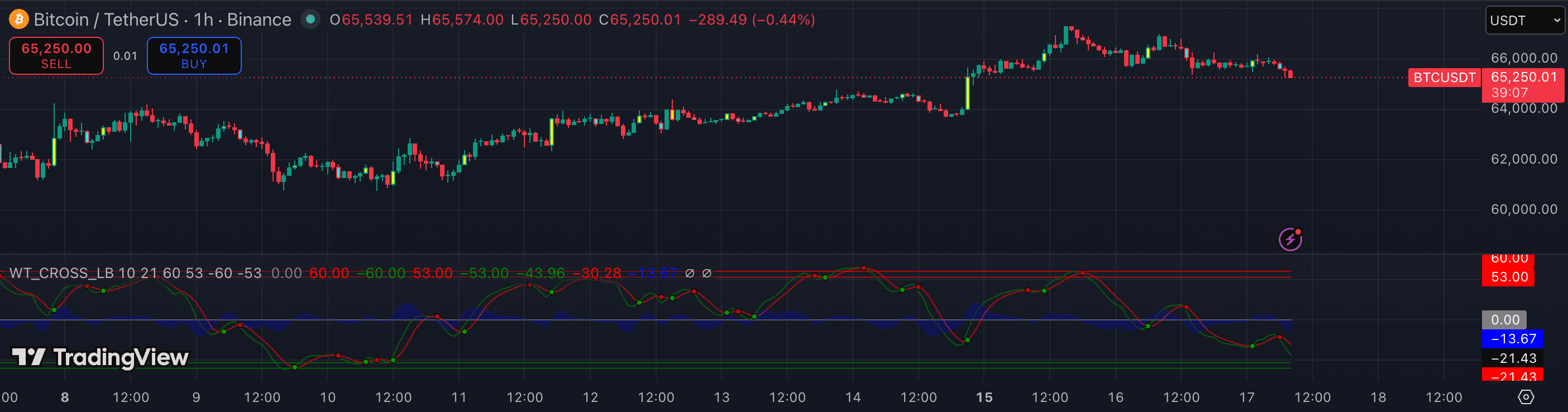
The WaveTrend Oscillator is a momentum indicator that uses a channel-normalized EMA-based calculation to produce two oscillating lines (WT1 and WT2), similar in appearance to a smoothed Stochastic but with fundamentally different math. In crypto, it has grown popular because it tends to produce cleaner overbought/oversold extremes than standard RSI on assets with heavy momentum swings. The default settings — channel length 10, average length 21 — were not specifically designed for crypto's 24/7 markets and require adjustment depending on your trading style. This guide covers the key settings and their practical effect. This content is for educational purposes only and does not constitute investment advice.
1. How WaveTrend calculates its signal
WaveTrend uses a two-step smoothing process. First, it calculates the typical price (HLC/3) and applies an EMA over the 'channel length' parameter to get a baseline. It then computes the mean deviation of price from that baseline and applies a second EMA (the 'average length') to smooth the normalized oscillator output. The result is two lines: WT1 (faster) and WT2 (a smoothed version of WT1), whose crosses are used as entry signals.
Because WaveTrend double-smooths its output, it naturally produces fewer raw cross signals than Stochastic or RSI at equivalent settings. The downside is more lag — WaveTrend crosses confirm a move after it has started, not at the very start. For crypto scalping where every bar matters, this lag can be a disadvantage; for swing trading where false signal avoidance is more valuable, it is an advantage.
2. Channel length: controls the sensitivity baseline
The channel length (default 10) sets the lookback for the baseline EMA from which deviation is calculated. A shorter channel length (6–8) makes WaveTrend more reactive — the oscillator hits overbought and oversold extremes more frequently and turns faster. A longer channel length (14–21) widens the reference window, making extreme readings rarer and the signals that do appear more significant.
For crypto day trading on 15m–1h, a channel length of 8–10 is appropriate — it gives enough responsiveness to capture intraday momentum cycles without excessive noise. For swing trading on 4h–daily, extending the channel length to 14–21 reduces signal frequency and concentrates WaveTrend signals on major market turning points.
3. Average length: controls signal smoothing
The average length (default 21) is the EMA applied to the normalized oscillator to produce WT1. A shorter average length (12–15) accelerates the WT1 response and makes WT1/WT2 crosses faster. A longer average length (25–30) slows the line and produces fewer, larger crosses that are more likely to correspond to meaningful momentum shifts.
The relationship between channel length and average length matters: if you shorten the channel length to increase sensitivity, also consider slightly shortening the average length to maintain the relative timing. Conversely, for slow swing setups, extending both parameters together (e.g. channel 14, average 28) keeps the internal ratio consistent.
4. Overbought/oversold levels and divergences
WaveTrend uses fixed overbought and oversold thresholds. Common settings: overbought at +60, oversold at -60 (the typical defaults). At these levels, WT1/WT2 crosses carry the most signal weight — a cross from below -60 (oversold) signals potential upside recovery; a cross from above +60 signals potential downside.
Divergence between WaveTrend and price is one of its most reliable signals in crypto. When price makes a lower low but WaveTrend makes a higher low (bullish divergence), the oscillator is indicating that selling momentum is weakening even as price drops. This type of divergence on the 4h or daily chart has preceded several significant BTC and altcoin bounces. However, divergences in strong trends can persist for many bars before resolving — they indicate a shift is building, not imminent.
5. Using WaveTrend as a trend filter
Beyond overbought/oversold signals, WaveTrend's position relative to zero carries directional information. When both WT1 and WT2 are above zero, momentum is bullish; below zero, bearish. Some traders use the zero-line position as a trend filter: only take long signals (WT crosses in oversold territory) when WT1 is above zero on the higher timeframe, and only take short signals when WT1 is below zero.
Combining WaveTrend's zero-line position on the daily chart with its cross signals on the 4h chart creates a multi-timeframe momentum system. The daily timeframe sets the directional bias; the 4h timeframe provides the entry timing. This layered approach reduces the number of counter-trend trades that lead to losses in sustained crypto trends.
- Trading WT1/WT2 crosses in the mid-range (between -60 and +60) — the majority of false signals occur in the neutral zone; restrict entries to crosses at overbought or oversold extremes.
- Using very short channel lengths (4–5) on lower timeframes — this creates a WaveTrend that oscillates continuously and loses its discrimination between meaningful and trivial momentum shifts.
- Acting on divergence signals immediately without waiting for a WaveTrend cross to confirm — divergences can persist for many bars in strong trends before price reverses.
- Treating WaveTrend as a standalone system — it is a momentum oscillator and requires a directional filter (price structure, higher-timeframe trend, moving average) to avoid trading counter-trend in sustained moves.
- Applying the same OB/OS thresholds (+60/-60) across all assets — on some altcoins with heavy momentum, WaveTrend regularly exceeds +100; consider extending thresholds to +80/-80 on higher-volatility assets.