Squeeze MomentumvsStochastic RSI
Squeeze Momentum and Stochastic RSI are both momentum tools, but they answer different timing questions. Squeeze Momentum combines volatility compression with directional momentum, while Stochastic RSI measures where RSI sits within its recent range. This comparison separates breakout context from faster pullback timing. Educational content only; not financial advice.
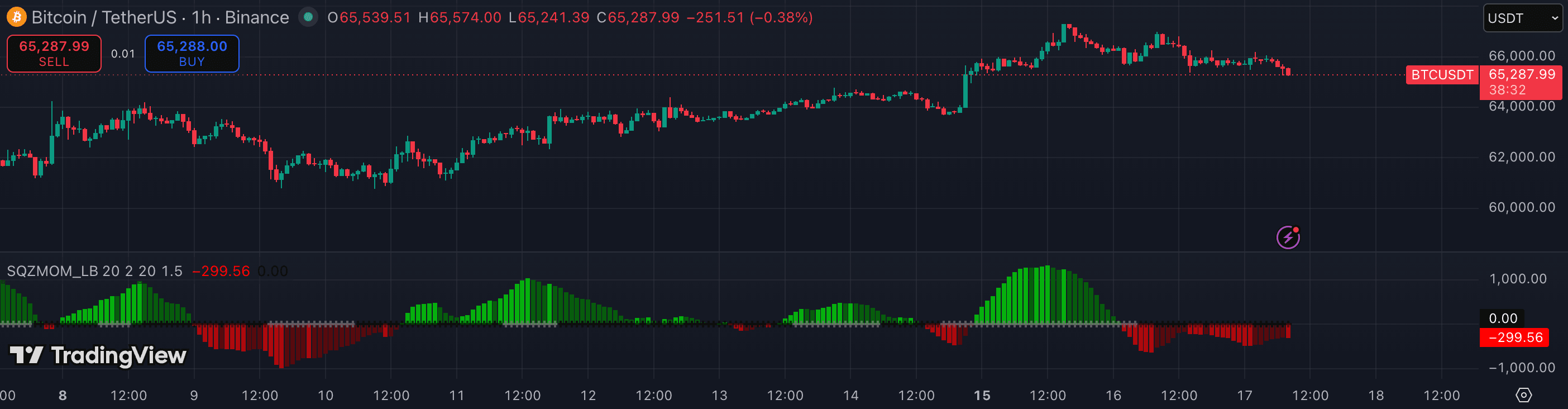
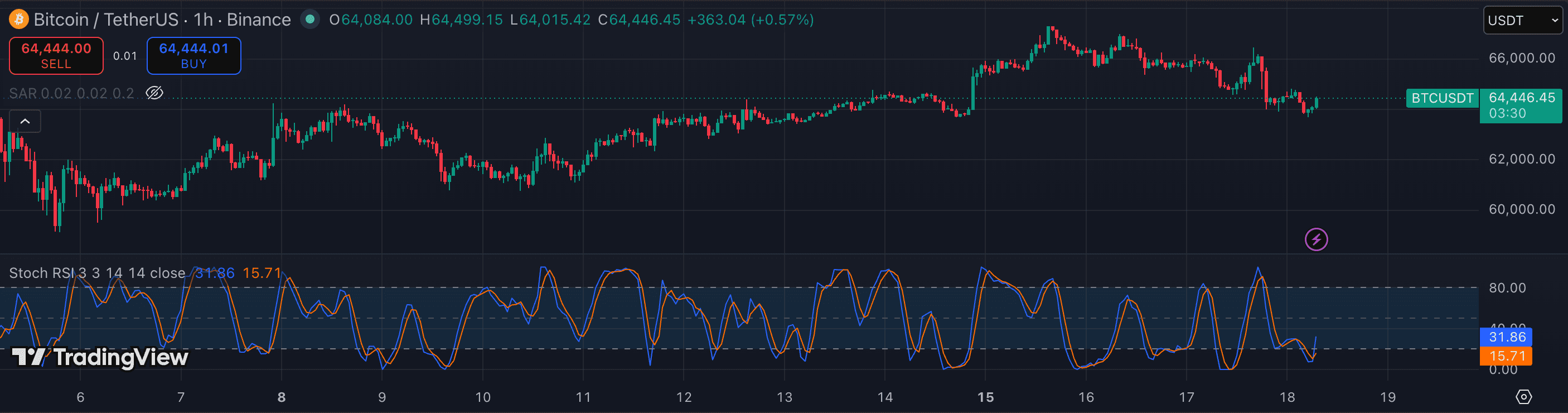
The attributes that matter.
| Attribute | Squeeze Momentum | Stochastic RSI |
|---|---|---|
| Primary question | Is volatility compressed or releasing, and which way is momentum leaning? | Where is RSI within its recent range, and how is short-term momentum turning? |
| Core calculation | Bollinger/Keltner compression state plus a momentum histogram | Stochastic formula applied to RSI, usually smoothed into %K and %D |
| Output | Squeeze-state dots and a directional histogram | Two oscillator lines on a bounded 0–100 scale |
| Typical timeframe | 1h · 4h · 1D | 15m · 1h · 4h |
| Signal frequency | Lower — centred on compression and release phases | Higher — reacts quickly and reaches extremes often |
| Best environment | Consolidation transitioning into volatility expansion | Pullbacks within an independently established directional context |
| Direction context | Histogram supplies a momentum lean, not certainty | Requires trend or structure context outside the oscillator |
| Main limitation | A squeeze release does not provide precise entry timing or establish follow-through | Sensitivity creates repeated crosses and extreme readings without a regime filter |
Which should you choose?
Squeeze Momentum is the broader setup tool. Its dots show whether Bollinger Bands are compressed inside Keltner Channels, while the histogram describes the direction and change of momentum around that state. This makes it useful for monitoring a consolidation before and during expansion, but the first release bar is not a complete decision rule and can still lead to a failed breakout.
Stochastic RSI is the faster timing tool. Because it applies the Stochastic calculation to RSI rather than directly to price, it moves rapidly between extremes and produces frequent %K/%D crosses. That responsiveness can help inspect pullbacks after trend direction is already defined, but it also creates noise when the chart is ranging or when an extreme reading is treated as an automatic reversal.
For a breakout-oriented workflow, Squeeze Momentum is usually the better first choice because it adds volatility-regime context as well as a momentum read. Choose Stochastic RSI when another method already supplies direction and the specific need is a sensitive entry-timing oscillator. They can be combined sequentially—compression context first, then a faster momentum turn—but agreement remains descriptive rather than predictive.
- You monitor consolidations for a transition into volatility expansion
- You want compression state and momentum direction in one pane
- You prefer fewer, event-based setups on 1h–1D charts
- You already have trend and structure context from another method
- You want a sensitive %K/%D oscillator for pullback timing
- You can filter frequent crosses on 15m–4h charts
Other comparisons
Not investment advice. PineRadar is an editorial directory — links may be affiliate. Always test indicators on a demo account.