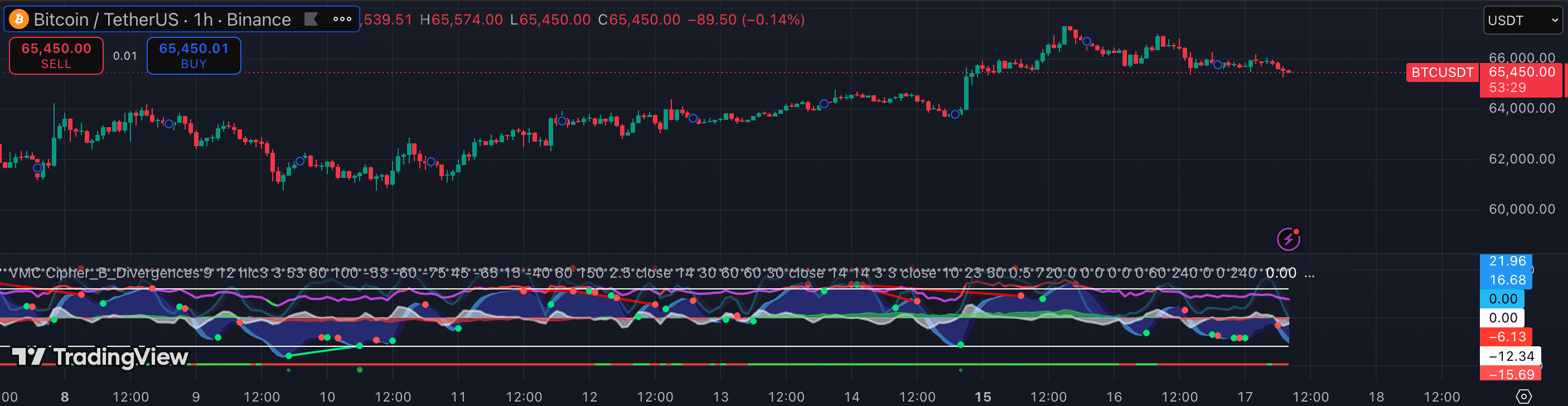
VuManChu Cipher B ships with sensible defaults, and most traders never touch them — which is fine for a first pass. But the two key settings, WaveTrend channel length and the overbought/oversold thresholds, have a meaningful impact on signal frequency and quality across different timeframes and market conditions. This guide maps the right parameters to each use case so you can cut noise without cutting the signals that matter. Educational content only; not investment advice.
1. Understand the two primary parameters
Cipher B has two tuneable levers that matter most: the WaveTrend channel length (default 9) and the average length (default 12), which together control how quickly the oscillator responds to price; and the overbought/oversold thresholds (default ±60), which determine where the extreme zones begin.
A shorter channel length reacts faster — more crossovers, more signals, more noise. A longer channel length is smoother — fewer crossovers, cleaner signals, more lag. The OB/OS thresholds control where the 'extreme' zone starts; raising them (to ±70 or ±80) means you only flag genuinely stretched readings, not every minor swing.
2. Tune OB/OS thresholds to your timeframe
On faster charts (1m–5m), the default ±60 thresholds fire extremely often — nearly every candle cluster pushes into the zone. Raise both to ±70 or ±75 to cut the noise and only flag genuinely stretched readings.
On slower charts (4h–1D), the default ±60 levels are appropriate and may even be tightened slightly to ±53–±55 to surface more signals on charts where extremes are rarer. This is the opposite of what most traders expect — slower charts need tighter thresholds, not wider ones.
3. Use money flow color to filter the wave crosses
The green/red money flow histogram sits below the WaveTrend wave and is as important as the crosses themselves. Only take WaveTrend crosses that align with the money flow color — a bullish cross (line turning up from the oversold zone) is higher quality when money flow is green, not red.
This one filter alone removes a large fraction of false signals without requiring any settings change — it is a usage discipline, not a parameter adjustment.
4. Match channel length to your market speed
The default channel length of 9 is calibrated for BTC/ETH on 15m–1h. For faster altcoins or lower timeframes where price moves more erratically, consider raising the channel length to 11–13 to smooth out the extra noise without significantly lagging the signal.
For swing setups on 4h and above, the default 9 is generally appropriate — fewer bars per period means the channel length has less relative impact. Test before changing.
- Taking every green/red dot without checking money flow direction — mid-range crosses without money flow confirmation are low-quality entries.
- Lowering OB/OS thresholds to get more signals — this adds noise, not edge. Fewer, confirmed signals are more tradeable than frequent, ambiguous ones.
- Using Cipher B against the trend — it is a mean-reversion oscillator. Fading a strong uptrend because the wave looks overextended consistently leads to early stops.
- Stacking it with WaveTrend Oscillator or RSI — these measure nearly the same thing. Cipher B already has a WaveTrend component; adding another oscillator creates redundancy, not confirmation.
- Changing both channel length and OB/OS at the same time — adjust one parameter at a time so you can isolate the effect.