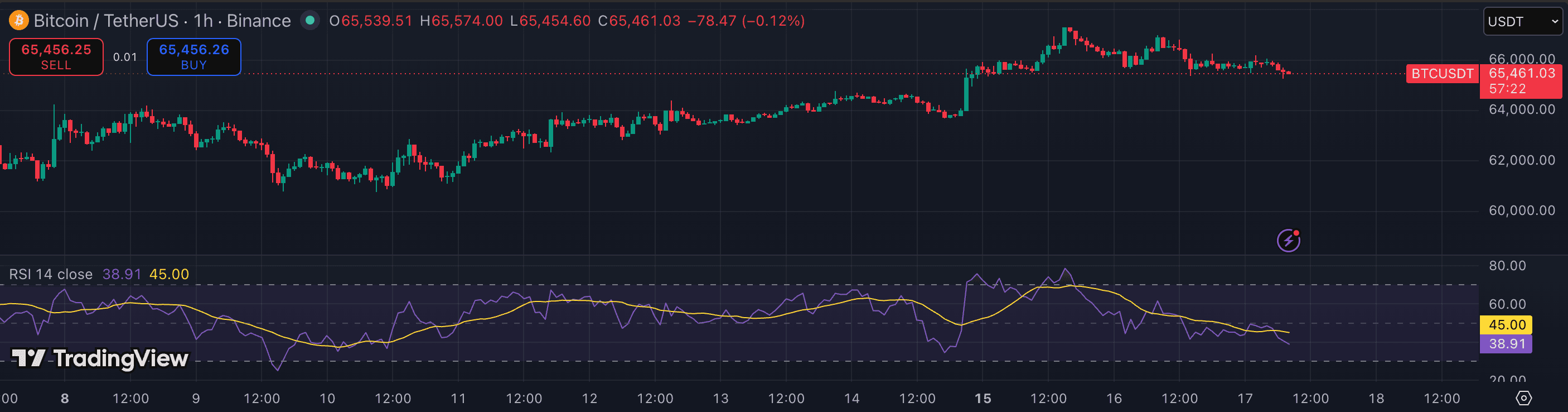
RSI divergence occurs when price and the RSI line move in opposite directions. A new price high paired with a lower RSI high is bearish divergence; a new price low paired with a higher RSI low is bullish divergence. The signal is compelling because it suggests momentum is fading before price confirms — giving traders early warning of a possible reversal. The catch is that divergence can persist for many bars before resolving, and trading it without confirmation is one of the most common ways traders get stopped out repeatedly. This guide covers how to read divergence correctly, when to act on it, and how to filter out the cases where it does not lead anywhere.
1. Set up RSI correctly for divergence reading
Use the default length of 14 on the timeframe you intend to trade. Do not shorten the length to 7 or 9 hoping to get earlier signals — a shorter RSI hits overbought and oversold so frequently that almost every bar looks like divergence, which is not actionable.
On crypto, RSI divergence is most reliable on 1h and above. Below 1h, individual candles carry too much noise for the signal to be consistent. If you want to scalp divergence on 15m, check the 1h first — only act on 15m divergence when the higher timeframe shows the same momentum fade.
2. Identify real divergence — not just misaligned swings
Bullish divergence requires two conditions: price makes a lower low AND RSI makes a higher low at approximately the same bars. Both swing lows should be clear, not ambiguous, and RSI should be in or near the oversold zone (below 40–50 in a downtrend).
Bearish divergence requires the mirror: price makes a higher high AND RSI makes a lower high, with RSI in or near the overbought zone (above 50–70 in an uptrend).
Common mistake: calling divergence when price barely makes a new high or low. For the signal to have weight, the price swing should be a genuinely new extreme — not a few ticks beyond the prior bar.
3. Wait for a confirmation trigger before entering
Divergence is a warning, not a trade. Entering the moment you spot it is how traders get caught by moves that push through the divergence extreme before reversing. You need a trigger that tells you the reversal is actually starting.
The most practical confirmation trigger is a structure break: price makes the new low (in bullish divergence), then closes back above the prior swing low. That candle close is your entry bar — the divergence said momentum was fading, and the structure break says price is now confirming it.
Alternative trigger: a WaveTrend or Stochastic RSI crossover at an oversold extreme occurring after the divergence has formed. The divergence sets the context; the oscillator crossover provides the timing.
4. Place the stop and size the trade
Stop placement in divergence trades is straightforward: below the price extreme that printed the divergence (the new low in bullish divergence, the new high in bearish). This is the level that, if broken, invalidates the divergence thesis — price moved beyond the point where momentum was supposed to be fading.
Because the stop is relatively close to entry (just beyond the extreme), divergence trades can offer favourable risk-reward without requiring a wide stop. Target the prior swing high (for bullish) or prior swing low (for bearish) as a first target — that is where many mean-reversion divergence trades stall.
5. Filter out low-quality divergence
Not all divergence leads to reversals. Three filters cut false signals significantly. First, timeframe: divergence on 1h or 4h carries far more weight than divergence on 5m. Second, location: divergence at a known structural level (a volume profile node, a prior swing, VWAP) is more reliable than divergence in open air. Third, trend context: bullish divergence in a downtrend is a potential counter-trend bounce — manage it as such, not as a new uptrend.
If RSI is making divergence but ADX is above 30, the market may be too strongly trending for the signal to resolve quickly. Divergence in a high-ADX environment is common and often fails. Wait for ADX to soften below 25 before treating divergence as high-probability.
- Entering the moment divergence appears — without a confirmation trigger. Divergence can extend much further than expected before resolving.
- Trading divergence against a high-ADX trend. A strong trend will push through oversold RSI repeatedly; wait for trend strength to weaken first.
- Calling divergence on ambiguous swing lows — the price swings and RSI swings must both be clearly defined pivot points, not noise.
- Using a short RSI length (7 or 9) for divergence reading — the extra sensitivity creates false divergence on nearly every bar.
- Placing stops too tight — they need to be beyond the price extreme that printed the divergence, not just behind the confirmation candle.